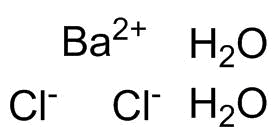
Barium chloride dihydrate, CAS 10326-27-9, is a water-soluble inorganic barium salt with the formula BaCl2·2H2O and a molecular weight of 244.26. It is commonly encountered as a laboratory reagent and a source of Ba2+ ions. One of its most familiar reactions is also one of the simplest demonstrations of precipitation chemistry: when soluble barium ions meet sulfate ions, they form an extremely insoluble white solid, barium sulfate.
The reaction can be represented by a remarkably short ionic equation:
Ba2+ + SO42− → BaSO4↓
This strong tendency to precipitate sulfate has made barium chloride a classic reagent for detecting and determining sulfate. In qualitative analysis, addition of barium chloride to a suitably acidified solution can reveal sulfate through formation of a dense white precipitate. In quantitative work, the same chemistry can be used gravimetrically: sulfate is converted into barium sulfate, the precipitate is collected and weighed, and the original amount of sulfate is calculated from the mass of BaSO4. Modern instrumental variations can instead measure the turbidity produced by suspended barium sulfate. Thus, a reaction familiar from introductory chemistry continues to have practical analytical value.
Barium chloride also occupies an unexpected place in the history of radioactivity. The reason lies in the periodic table. Barium and radium are both alkaline-earth elements, with radium directly below barium. Their ions have similar chemical behavior, and this similarity created an enormous challenge when Marie and Pierre Curie investigated the strongly radioactive material present in residues from uranium ores.
The new radioactive substance followed barium during chemical separations. This was useful because barium could act as a chemical carrier, but it also meant that separating the unknown element from barium was extremely difficult. Ordinary precipitation methods could not simply distinguish two elements whose salts behaved so similarly.
Marie Curie eventually exploited a small difference rather than a large one. Radium chloride is less soluble than barium chloride. A mixture containing both chlorides could therefore be dissolved and allowed to crystallize partially. The crystals were somewhat richer in radium, while the remaining solution was poorer in it. The enriched crystals could then be dissolved again and the operation repeated.
One crystallization accomplished very little.
Hundreds or thousands of repetitions could accomplish something extraordinary.
Curie's own account describes fractional crystallization first from water and later from hydrochloric-acid-containing solutions. After crystallization, the solid fraction was more radioactive than the material remaining in solution. Repeated separation progressively concentrated the radium. She also investigated fractional precipitation with alcohol before favoring crystallization as the more regular method.
The work illustrates one of the most powerful ideas in separation science. Two substances do not need dramatically different properties to be separated. If a small difference can be applied repeatedly, enrichment accumulates from one stage to the next. Fractional distillation, recrystallization, chromatography, and many modern purification processes rely on variations of the same underlying logic.
Barium chloride itself was also subjected to an illuminating control experiment. Curie wanted to know whether ordinary commercial barium might naturally contain a tiny amount of the radioactive substance. She began with 50 kilograms of commercial barium chloride and repeatedly fractionated it until only about 10 grams of the least soluble fraction remained. That material showed no detectable radioactivity under the experimental conditions. The result helped demonstrate that the extraordinary activity associated with the uranium-ore material was not an ordinary property of barium.
The historical importance of barium chloride therefore comes from an apparent contradiction. Barium was useful because its chemistry was so similar to radium that the two traveled together during separation. Yet that same similarity made purification difficult. The solution was to exploit the slight difference in solubility between their chlorides repeatedly until an initially tiny distinction became large enough to isolate increasingly concentrated radium material.
Today, barium chloride dihydrate is far more likely to be encountered in an analytical laboratory than in a search for a new radioactive element. Its reaction with sulfate remains especially important because barium sulfate is so insoluble. The same property is also relevant industrially when soluble sulfate must be removed from process streams or brines. Barium chloride has additionally been used as a starting material for preparing other barium compounds and in specialized industrial processes.
Soluble barium compounds require careful handling because Ba2+ is toxic. This creates another instructive contrast with barium sulfate. Although both contain the element barium, their behavior cannot be judged simply from the element name. Barium chloride dissolves readily enough to provide biologically available barium ions, whereas barium sulfate is exceptionally insoluble. Chemical form and solubility can therefore matter as much as elemental composition when considering the behavior of a substance.
Barium chloride dihydrate connects several levels of chemistry unusually well. In a teaching laboratory, one drop can produce the familiar white cloud that identifies sulfate. In quantitative analysis, the same precipitation can become a measurement. And in the history of science, the subtle difference between barium chloride and radium chloride became a tool for separating two remarkably similar elements.
The chemistry can be summarized by two very different kinds of separation. Add sulfate, and barium separates almost immediately as insoluble BaSO4. Mix barium chloride with radium chloride, and separation becomes painfully difficult, requiring repeated crystallization. One reaction happens in seconds; the other helped define years of painstaking work. Together they show that much of analytical and separation chemistry depends on one question: how differently can two substances be persuaded to behave?
References
1. Curie, M. (1904). Radio-Active Substances. Description of the preparation of radium chloride by fractional crystallization of barium and radium chlorides.
2. U.S. Environmental Protection Agency. Methods and technical literature describing precipitation of sulfate with barium chloride and measurement of the resulting barium sulfate.
3. ISO 9280. Water quality - Determination of sulfate - Gravimetric method using barium chloride. Use of barium chloride dihydrate solution for sulfate determination.
4. Merck/Supelco. Barium chloride dihydrate, CAS 10326-27-9. Formula BaCl2·2H2O; molecular weight 244.26; analytical reagent specifications.
|








 GHS06;GHS07 Danger Details
 chemBlink Chemical Story