
Online Database of Chemicals from Around the World
| Amadis Chemical Co., Ltd. | China | |||
|---|---|---|---|---|
 | www.amadischem.com | |||
 | +86 (571) 8992-5085 | |||
 | +86 (571) 8992-5065 | |||
 | sales@amadischem.com | |||
| Chemical manufacturer since 2010 | ||||
| chemBlink Standard supplier since 2015 | ||||
| Coresyn Pharmatech Co., Ltd. | China | |||
|---|---|---|---|---|
| www.coresyn.com | |||
| +86 (571) 8662-6709 | |||
| sales@coresyn.com | |||
| Chemical manufacturer | ||||
| chemBlink Standard supplier since 2016 | ||||
| INA Pharmaceuticals Pvt. Ltd. | India | |||
|---|---|---|---|---|
| inapharma.in | |||
| +91 7815933367 | |||
| rd@inapharma.in | |||
| Chemical manufacturer since 2018 | ||||
| chemBlink Standard supplier since 2026 | ||||
| Atlantic Research Chemicals Ltd. | UK | |||
|---|---|---|---|---|
| www.atlantic-chemicals.com | |||
| +44 (8707) 746-454 | |||
| +44 (8707) 746-455 | |||
| info@atlantic-chemicals.com | |||
| Chemical manufacturer | ||||
| Achemica | Switzerland | |||
|---|---|---|---|---|
| www.achemica.com | |||
| +41 (24) 466-2929 | |||
| +41 (24) 466-2800 | |||
| contact@achemica.com | |||
| Chemical manufacturer since 2010 | ||||
| Classification | Organic raw materials >> Carboxylic compounds and derivatives |
|---|---|
| Name | trans-1,2-Cyclobutanedicarboxylic acid |
| Synonyms | NSC 527264 |
| Molecular Structure | 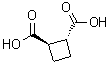 |
| Molecular Formula | C6H8O4 |
| Molecular Weight | 144.13 |
| CAS Registry Number | 1124-13-6 |
| EC Number | 214-392-8 |
| SMILES | C1C[C@H]([C@@H]1C(=O)O)C(=O)O |
| Solubility | Soluble (59 g/L) (25 °C), Calc.* |
|---|---|
| Density | 1.509±0.06 g/cm3 (20 °C 760 Torr), Calc.* |
| Melting point | 131-131.5 °C (Expl.) |
| Boiling point | 377.7±35.0 °C 760 mmHg (Calc.)* |
| Flash point | 196.4±22.4 °C (Calc.)* |
| Index of refraction | 1.555 (Calc.)*, 1.4556 (589.3 nm 25 °C) (Expl.) |
| * | Calculated using Advanced Chemistry Development (ACD/Labs) Software. |
| Hazard Symbols |  GHS07 Warning Details GHS07 Warning Details | ||||||||||||||||||||||||
|---|---|---|---|---|---|---|---|---|---|---|---|---|---|---|---|---|---|---|---|---|---|---|---|---|---|
| Risk Statements | H315-H319-H335 Details | ||||||||||||||||||||||||
| Safety Statements | P261-P264-P264+P265-P271-P280-P302+P352-P304+P340-P305+P351+P338-P319-P321-P332+P317-P337+P317-P362+P364-P403+P233-P405-P501 Details | ||||||||||||||||||||||||
| Hazard Classification | |||||||||||||||||||||||||
| |||||||||||||||||||||||||
| SDS | Available | ||||||||||||||||||||||||
 chemBlink Chemical Story
|
trans-1,2-Cyclobutanedicarboxylic acid, CAS 1124-13-6, is a small cyclic dicarboxylic acid used primarily as a research reagent and synthetic building block. Its molecular formula is C6H8O4 and its molecular weight is 144.13. The molecule consists of a four-membered cyclobutane ring bearing two carboxylic acid groups on adjacent carbon atoms. What makes it particularly interesting is not simply the presence of two carboxyl groups, but their three-dimensional relationship: in the trans isomer, they are directed toward opposite faces of the ring. This apparently minor spatial distinction introduces the subject of stereochemistry. Cyclobutane-1,2-dicarboxylic acid can exist in cis and trans forms. In the cis isomer, the two carboxyl-bearing substituents are oriented toward the same face of the cyclobutane framework; in the trans isomer, they occupy opposite faces. The molecules have the same molecular formula and the same connectivity, yet they are distinct compounds because their atoms are arranged differently in three-dimensional space. The trans compound introduces another level of stereochemical detail. With two stereogenic ring carbons, the trans form occurs as a pair of mirror-image configurations, commonly represented as (1R,2R) and (1S,2S). An ordinary sample described as (±)-trans-1,2-cyclobutanedicarboxylic acid can therefore be racemic, containing equal amounts of the two enantiomers. This contrasts with the corresponding cis arrangement, whose symmetry leads to different stereochemical behavior. The four-membered ring is itself chemically noteworthy. Cyclobutane cannot adopt the relatively strain-free geometry available to larger carbon rings. Its carbon-carbon bonds are forced into a constrained arrangement, producing significant ring strain. The ring is also not perfectly planar; slight puckering reduces some eclipsing interactions. These structural characteristics give cyclobutane derivatives geometries and conformational behavior different from those of open-chain compounds. For synthetic and medicinal chemists, this constraint can be useful. A flexible carbon chain can rotate around several bonds and explore many conformations. A cyclobutane ring restricts that movement and holds attached groups in a more defined spatial relationship. Incorporating a cyclobutane unit into a larger molecule can therefore change molecular shape without requiring a large or complicated scaffold. This idea has become increasingly important in medicinal chemistry. Cyclobutanes and other small saturated rings are frequently investigated as rigid or semi-rigid replacements for flexible portions of candidate molecules. The goal is not that a cyclobutane automatically improves biological activity, but that changing molecular geometry can influence how a compound fits into a protein binding site, how polar groups are displayed, and how the molecule behaves physically and metabolically. trans-1,2-Cyclobutanedicarboxylic acid is particularly useful conceptually because its two carboxyl groups provide functional handles while the ring defines their relative orientation. Carboxylic acids can be transformed into esters, amides, acid chlorides, salts, alcohols, and numerous other derivatives. The two groups can therefore serve as connection points for incorporating the cyclobutane framework into more elaborate molecular structures. The compound also provides a classic illustration of how stereoisomers can display different physical and chemical behavior. Historical studies of cyclobutane-1,2-dicarboxylic acids examined the cis and trans forms separately, including their ionization, derivatives, thermal behavior, and mass-spectral fragmentation. The different spatial relationship between the two carboxyl groups can influence how readily they interact with one another and how the molecule behaves during chemical transformations. One particularly interesting observation is that the cis isomer can be converted into the thermodynamically favored trans form under sufficiently vigorous acidic conditions. Classical preparative literature reports isomerization of cis-cyclobutane-1,2-dicarboxylic acid by heating with concentrated hydrochloric acid. Such experiments helped early organic chemists establish relationships among stereoisomers long before modern computational visualization made three-dimensional molecular structures easy to inspect. Today, trans-1,2-cyclobutanedicarboxylic acid is commercially available principally for research and further manufacturing. Suppliers describe it as a pharmaceutical synthesis intermediate, but this should not be interpreted as evidence that the compound itself has pharmaceutical activity. Its practical value is as a compact stereochemically defined dicarboxylic-acid building block that can be transformed into more complex structures. The molecule therefore illustrates an important lesson in chemistry: molecular identity is determined by more than a list of atoms and bonds. Two molecules can contain exactly the same atoms connected in exactly the same order and still behave as different substances because those atoms point in different directions in space. For trans-1,2-cyclobutanedicarboxylic acid, that lesson is compressed into a ring containing only four carbon atoms. Two carboxyl groups, one tiny strained ring, and the choice between "same side" and "opposite sides" are enough to open a surprisingly rich discussion of stereochemistry, molecular shape, ring strain, and the design of synthetic building blocks. References 1. NIST Chemistry WebBook, SRD 69. 1,2-Cyclobutanedicarboxylic acid, trans-. CAS 1124-13-6. https://webbook.nist.gov/cgi/inchi?ID=C1124136 2. PubChem. (±)-trans-1,2-Cyclobutanedicarboxylic acid, CID 10888028. CAS 1124-13-6. https://pubchem.ncbi.nlm.nih.gov/compound/10888028 3. Fieser, L. F.; Pechet, M. M. (1946). "Cyclobutane-1,2-dicarboxylic Acids." Journal of the American Chemical Society, 68. 4. Reed, R. I. (1951). Studies involving cis- and trans-cyclobutane-1,2-dicarboxylic acids. Journal of the Chemical Society, 685. 5. McMurry, J. (2023). Organic Chemistry. OpenStax. Stereochemical representation and nomenclature of trans-1,2-cyclobutanedicarboxylic acid. |
| Market Analysis Reports |