
Online Database of Chemicals from Around the World
| BOC Sciences | USA | |||
|---|---|---|---|---|
 | www.bocsci.com | |||
 | +1 (631) 485-4226 | |||
 | +1 (631) 614-7828 | |||
 | info@bocsci.com | |||
| Chemical manufacturer | ||||
| chemBlink Standard supplier since 2010 | ||||
| Hangzhou Leap Chem Co., Ltd. | China | |||
|---|---|---|---|---|
| www.leapchem.com | |||
| +86 (571) 8771-1850 | |||
| market19@leapchem.com | |||
 | QQ Chat | |||
| Chemical manufacturer since 2006 | ||||
| chemBlink Standard supplier since 2015 | ||||
| Ningbo Easun Biological Technology Co., Ltd. | China | |||
|---|---|---|---|---|
| www.easunbiotech.com | |||
| +86 (574) 6208-9878 +86 18657120662 | |||
| +86 (574) 6208-9877 | |||
| sales@easunbiotech.com | |||
| QQ Chat | |||
| Chemical manufacturer since 2015 | ||||
| chemBlink Standard supplier since 2015 | ||||
| Jinan Create Pharmaceutical Technology Co., Ltd. | China | |||
|---|---|---|---|---|
| www.jngcpharm.com | |||
| +86 (531) 8806-5293 | |||
| +86 (531) 8806-5293 | |||
| 3166282224@qq.com | |||
| Chemical manufacturer since 2013 | ||||
| chemBlink Standard supplier since 2016 | ||||
| Puripharm Inc | China | |||
|---|---|---|---|---|
| www.puripharm.com | |||
| +86 (572) 274-5768 | |||
| sales@puripharm.com | |||
| Chemical manufacturer since 2015 | ||||
| chemBlink Standard supplier since 2017 | ||||
| INA Pharmaceuticals Pvt. Ltd. | India | |||
|---|---|---|---|---|
| inapharma.in | |||
| +91 7815933367 | |||
| rd@inapharma.in | |||
| Chemical manufacturer since 2018 | ||||
| chemBlink Standard supplier since 2026 | ||||
| Advanced Synthesis | USA | |||
|---|---|---|---|---|
| www.advancedsynthesis.com | |||
| +1 (619) 423-7821 | |||
| +1 (619) 423-7793 | |||
| sales@advancedsynthesis.com | |||
| Chemical manufacturer | ||||
| Dalton Pharma Services | Canada | |||
|---|---|---|---|---|
| www.dalton.com | |||
| +1 (416) 661-2102 | |||
| +1 (416) 661-2108 | |||
| chemist@dalton.com | |||
| Chemical manufacturer | ||||
| Classification | Analytical chemistry >> Standard >> Pharmacopoeia standards and magazine standards |
|---|---|
| Name | Pteroic Acid |
| Synonyms | Folic Acid Impurity D; 4-[(2-amino-4-oxo-3H-pteridin-6-yl)methylamino]benzoic acid; p-[(2-Amino-4-hydroxy-6-pteridylmethyl)amino]benzoic acid |
| Molecular Structure | 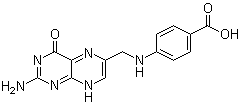 |
| Molecular Formula | C14H12N6O3 |
| Molecular Weight | 312.28 |
| CAS Registry Number | 119-24-4 |
| EC Number | 601-589-2 |
| SMILES | C1=CC(=CC=C1C(=O)O)NCC2=CN=C3C(=N2)C(=O)NC(=N3)N |
| Density | 1.7±0.1 g/cm3 Calc.* |
|---|---|
| Melting point | >400 °C (Expl.) |
| Index of refraction | 1.803 (Calc.)* |
| * | Calculated using Advanced Chemistry Development (ACD/Labs) Software. |
| Hazard Symbols |  GHS07 Warning Details GHS07 Warning Details | ||||||||||||||||
|---|---|---|---|---|---|---|---|---|---|---|---|---|---|---|---|---|---|
| Risk Statements | H302-H315-H319-H335 Details | ||||||||||||||||
| Safety Statements | P261-P264-P264+P265-P270-P271-P280-P301+P317-P302+P352-P304+P340-P305+P351+P338-P319-P321-P330-P332+P317-P337+P317-P362+P364-P403+P233-P405-P501 Details | ||||||||||||||||
| Hazard Classification | |||||||||||||||||
| |||||||||||||||||
| SDS | Available | ||||||||||||||||
 chemBlink Chemical Story
|
Pteroic acid, CAS 119-24-4, is a naturally relevant pteridine compound best understood as the central structural core of folic acid and the broader folate family. Its molecular formula is C14H12N6O3 and its molecular weight is 312.29. Unlike folic acid, pteroic acid does not contain the glutamic acid residue that characterizes pteroylglutamic acid. This apparently simple difference places pteroic acid at an important intersection of vitamin chemistry, biochemistry, analytical science, and the synthesis of folate-related molecules. The relationship is easiest to understand by looking at folic acid as a molecule assembled from three recognizable parts: a pteridine ring system, p-aminobenzoic acid, and glutamic acid. The first two together form pteroic acid. Attaching L-glutamic acid to the carboxyl group of pteroic acid produces folic acid, historically called pteroylglutamic acid. IUPAC-IUB biochemical nomenclature therefore treats pteroic acid as the parent skeleton on which folates are based. Folates can contain one or more glutamate units attached to this core. This structural relationship is important biologically. Folates participate in one-carbon metabolism after conversion into reduced tetrahydrofolate derivatives. These coenzymes transfer one-carbon units in reactions required for purine and thymidylate synthesis, amino-acid metabolism, and other essential cellular processes. Pteroic acid itself, however, should not simply be described as equivalent to folic acid or as having the same vitamin activity. Removing the glutamate portion changes transport, enzyme recognition, and biological utilization. Pteroic acid is also useful for understanding how folate molecules can be dismantled. Enzymes known as carboxypeptidase G can cleave the bond linking the pteroate portion of folic acid to glutamate. This reaction has been exploited experimentally as a practical method for preparing pteroic acid from folic acid. Published procedures describe dissolving folic acid in buffered solution, treating it with carboxypeptidase G, and isolating the resulting pteroic acid after removal of glutamate. The same chemistry has an important pharmacological counterpart. Several antifolate drugs resemble folates closely enough to interact with folate-dependent biochemical pathways. Carboxypeptidase G2, also known as glucarpidase, can hydrolyze methotrexate by removing its terminal glutamate-like portion, producing metabolites with greatly reduced pharmacological activity. Pteroic acid is not the methotrexate metabolite, but the underlying cleavage chemistry illustrates why the pteroate-glutamate connection is so important in folate and antifolate structures. Pteroic acid has also become useful as a synthetic starting material for folate derivatives. The carboxyl group on its p-aminobenzoic acid portion provides a convenient position at which chemists can attach amino acids, linkers, peptides, fluorescent groups, imaging agents, or other molecular cargo. In effect, chemists can use pteroic acid as a preassembled folate-recognition framework and then decide what to attach where glutamate would normally appear. This strategy is particularly relevant to folate-receptor research. Folate receptors are cell-surface proteins capable of binding folate-related structures with high affinity, and some tumors overexpress folate receptor α. Consequently, folate chemistry has been widely explored as a way to deliver diagnostic or therapeutic cargo selectively to folate-receptor-positive cells. Pteroic acid and protected pteroate derivatives appear in synthetic routes for such conjugates because they provide access to the characteristic pteridine-p-aminobenzoate portion of folate. A useful example comes from the development of folate-linked imaging and targeting molecules. Researchers can activate the carboxyl group of pteroic acid, protect other reactive positions when necessary, and couple the molecule to an amino-containing linker. The resulting conjugate can then be extended with peptides, chelating groups, fluorophores, or other components. Patent literature likewise describes pteroic acid as a starting reagent for preparing defined folate derivatives used in folate assays and related analytical applications. This chemistry highlights an important practical issue: attachment position matters. Folic acid contains multiple carboxyl groups once glutamate is present, and conjugation can produce mixtures if the chemistry is not carefully controlled. Starting from pteroic acid allows chemists to build the glutamate replacement or linker deliberately, giving greater control over the structure of the resulting folate derivative. Pteroic acid also occurs as a folic acid degradation product. Because folates can undergo chemical, photochemical, enzymatic, and microbial transformations, pteroic acid may appear during studies of folate stability or metabolism. This is one reason it can be encountered as a folic acid-related substance or impurity standard in analytical chemistry. Its presence does not mean that it should be treated nutritionally as folic acid; rather, it can provide information about what has happened to a folate-containing material. Historically, the chemistry of pteroic acid is inseparable from the discovery and structural characterization of folic acid. Once researchers recognized that the vitamin contained a pteridine-containing pteroate portion joined to glutamate, synthesis and degradation studies of these components helped establish the architecture of the folate molecule. The name "pteroic acid" has consequently remained embedded in biochemical nomenclature: folic acid is pteroylglutamic acid, literally the glutamate derivative of pteroic acid. Pteroic acid therefore occupies an unusual position. It is neither simply a vitamin nor merely an obscure synthetic intermediate. It is the molecular framework that helps define an entire vitamin family. Remove glutamate from folic acid and the underlying pteroic acid skeleton becomes visible; attach new molecular components to that skeleton and it becomes a starting point for folate probes, analytical reagents, and targeted conjugates. Few compounds illustrate so clearly how understanding a vitamin can begin by taking it apart and studying the pieces. References 1. IUPAC-IUB Commission on Biochemical Nomenclature. "Nomenclature and Symbols for Folic Acid and Related Compounds." Biochemical nomenclature recommendations for pteroic acid, folates, and pteroylglutamates. https://iupac.qmul.ac.uk/misc/folic.html 2. Shane, B. (2011). "Folate Chemistry and Metabolism." In: Bailey, L. B. (ed.), Folate in Health and Disease, 2nd ed. CRC Press. 3. Luo, J.; Smith, M. D.; Lantrip, D. A.; Wang, S.; Fuchs, P. L. (1997). "Efficient syntheses of pyrazolo[3,4-d]pyrimidine-based folate analogs: total synthesis of thiarabine." Journal of the American Chemical Society, 119, 10004-10013. 4. Smith, B. D.; Higgin, J. J.; Raines, R. T. (2011). "Site-specific folate conjugation to a cytotoxic protein." Bioorganic & Medicinal Chemistry Letters, 21, 5029-5032. 5. U.S. Patent US10640505B2. Folate derivatives, useful in particular in the context of the folate assay. Synthetic use of pteroic acid in defined folate derivatives. https://patents.google.com/patent/US10640505B2/en |
| Market Analysis Reports |