
Online Database of Chemicals from Around the World
| Xi'an Reapsource Biotechnology Co., Ltd. | China | |||
|---|---|---|---|---|
 | www.rpybiotech.com | |||
 | +86 18991103357 | |||
 | buyun.ping@rpybiotech.com | |||
 | QQ Chat | |||
 | WeChat: 18991103357 | |||
| Chemical manufacturer since 2024 | ||||
| chemBlink Standard supplier since 2026 | ||||
| Classification | Chemical reagent >> Deuterated reagent |
|---|---|
| Name | 1,3,5-Trichlorobenzene-d3 |
| Molecular Structure | 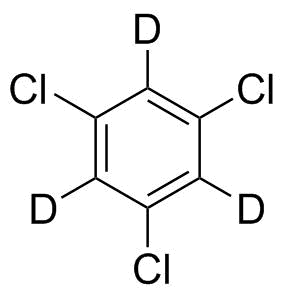 |
| Molecular Formula | C6D3Cl3 |
| Molecular Weight | 184.47 |
| CAS Registry Number | 1198-60-3 |
| EC Number | 690-099-2 |
| SMILES | [2H]C1=C(C(=C(C(=C1Cl)[2H])Cl)[2H])Cl |
| Density | 1.4±0.1 g/cm3 Calc.* |
|---|---|
| Melting point | 56 - 60 °C (Expl.) |
| Boiling point | 211.3±20.0 °C 760 mmHg (Calc.)*, 208 °C (Expl.) |
| Flash point | 126.7 °C (Calc.)*, 127 °C (Expl.) |
| Index of refraction | 1.567 (Calc.)* |
| * | Calculated using Advanced Chemistry Development (ACD/Labs) Software. |
| Hazard Symbols |  GHS07 Warning Details GHS07 Warning Details | ||||||||||||||||||||||||||||||||
|---|---|---|---|---|---|---|---|---|---|---|---|---|---|---|---|---|---|---|---|---|---|---|---|---|---|---|---|---|---|---|---|---|---|
| Risk Statements | H302+H312+H332-H302-H312-H315-H319-H332-H335-H412 Details | ||||||||||||||||||||||||||||||||
| Safety Statements | P261-P264-P264+P265-P270-P271-P273-P280-P301+P317-P302+P352-P304+P340-P305+P351+P338-P317-P319-P321-P330-P332+P317-P337+P317-P362+P364-P403+P233-P405-P501 Details | ||||||||||||||||||||||||||||||||
| Hazard Classification | |||||||||||||||||||||||||||||||||
| |||||||||||||||||||||||||||||||||
| SDS | Available | ||||||||||||||||||||||||||||||||
 chemBlink Chemical Story
|
1,3,5-Trichlorobenzene-d3 is a deuterium-labeled analog of 1,3,5-trichlorobenzene in which three hydrogen atoms on the aromatic ring are replaced by deuterium, the stable isotope of hydrogen. Isotopically labeled compounds such as 1,3,5-trichlorobenzene-d3 have become important tools in analytical chemistry, environmental science, and chemical research because they possess nearly identical chemical properties to their non-labeled counterparts while being distinguishable by spectroscopic and mass-spectrometric methods. The significance of 1,3,5-trichlorobenzene-d3 is therefore associated primarily with its use as a reference material, internal standard, and research reagent rather than as a commercial industrial chemical. The development of deuterium-labeled aromatic compounds was closely linked to advances in isotope chemistry during the twentieth century. As analytical techniques became increasingly sophisticated, researchers recognized the value of stable isotopes for tracing chemical behavior and improving quantitative measurements. Deuterium-labeled compounds could be introduced into experimental systems without substantially altering the chemistry of the parent molecule, making them especially useful for analytical applications. This approach led to the preparation of numerous isotopically labeled halogenated aromatic compounds, including labeled chlorobenzenes. 1,3,5-Trichlorobenzene itself has long been recognized as a chlorinated aromatic hydrocarbon of environmental and industrial interest. The preparation of a deuterated analog enabled researchers to distinguish the labeled compound from naturally occurring or experimentally generated non-labeled material. Because the mass difference introduced by deuterium can be readily detected, 1,3,5-trichlorobenzene-d3 became useful in analytical procedures requiring accurate quantification of chlorinated aromatic compounds. One of the most important applications of 1,3,5-trichlorobenzene-d3 is as an internal standard in chromatographic and mass-spectrometric analysis. Stable isotope-labeled standards are widely employed because they behave similarly to the analytes being measured during extraction, separation, and detection processes. The deuterated compound can therefore be added to samples in known amounts, allowing analysts to improve the accuracy and reliability of quantitative measurements. This practice has become a standard approach in environmental and analytical laboratories. The compound has also been used in environmental research involving chlorinated aromatic substances. Investigators studying the occurrence, transport, and fate of chlorinated compounds require reliable analytical methods capable of detecting trace quantities in complex samples. Isotopically labeled standards such as 1,3,5-trichlorobenzene-d3 have supported the development and validation of these methods by providing well-characterized reference materials for calibration and quality control purposes. Another documented application is in method development and instrument validation. Laboratories employing gas chromatography, mass spectrometry, and related analytical techniques often use isotopically labeled compounds to evaluate extraction efficiency, instrument performance, and analytical reproducibility. Because the labeled compound can be differentiated from the target analyte while exhibiting similar chemical behavior, it serves as an effective tool for assessing method accuracy. The compound has further been utilized in research involving isotope effects and labeled-molecule behavior. Although deuterium substitution generally does not significantly alter the overall chemical identity of aromatic compounds, isotopically labeled materials provide valuable opportunities to investigate reaction pathways, molecular transformations, and analytical processes. Such studies have contributed to the broader understanding of isotope-labeled substances in chemistry. The importance of 1,3,5-trichlorobenzene-d3 therefore derives from its role as a stable isotope-labeled reference compound. Published scientific and technical literature document the widespread use of deuterated aromatic compounds in analytical chemistry, environmental monitoring, and laboratory quality assurance. Through its application as an internal standard, calibration material, and research reagent, 1,3,5-trichlorobenzene-d3 has contributed to the accurate measurement and study of chlorinated aromatic compounds in a variety of scientific fields. |
| Market Analysis Reports |