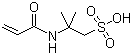
2-Acrylamido-2-methylpropanesulfonic acid, commonly abbreviated AMPS, is a functional vinyl monomer whose importance comes from an unusual combination of chemical features within one relatively small molecule. It contains a polymerizable carbon-carbon double bond, an amide group, and a strongly acidic sulfonic acid group. Together, these features allow chemists to incorporate permanent hydrophilicity and strong ionic character into polymers designed to function in water, brine, and other demanding environments.
The central idea behind AMPS is functional polymer design. Traditional polymers are often selected primarily for their mechanical properties, but many modern applications require materials that actively interact with their surroundings. A polymer may need to remain dissolved in concentrated salt water, prevent mineral deposits from forming, stabilize particles in suspension, absorb large quantities of water, or maintain viscosity at elevated temperatures. Rather than creating an entirely new polymer for each requirement, chemists can introduce a functional comonomer such as AMPS into an existing polymer architecture.
AMPS is particularly effective because its sulfonic acid group is strongly ionized in aqueous environments. When incorporated into a polymer chain, these ionic groups attract water and create electrostatic interactions that strongly influence polymer conformation, solubility, and interactions with dissolved ions and surfaces. The amide linkage contributes additional polarity, while the substituted carbon adjacent to the amide improves resistance to hydrolysis compared with some simpler acrylamide-derived structures.
These properties became especially valuable in water treatment. AMPS-containing copolymers are used as dispersants and scale-control agents in systems where calcium, magnesium, silica, and other mineral components can otherwise accumulate on heat-transfer surfaces and inside pipes. Instead of simply dissolving existing scale, appropriately designed polymers interfere with crystal growth and help keep small particles dispersed, allowing industrial water systems to operate more reliably.
An even more demanding application developed in oilfield chemistry. Drilling, completion, hydraulic fracturing, and enhanced oil recovery can expose polymers to combinations of high temperature, high salinity, pressure, and multivalent metal ions. Conventional water-soluble polymers may lose viscosity or undergo hydrolysis under these conditions. Incorporating AMPS into copolymers has become an important strategy for improving thermal and salt tolerance. AMPS-based polymers are therefore found in drilling fluids, fluid-loss-control systems, scale inhibitors, friction reducers, and gels designed for reservoir water management.
The same molecular characteristics have taken AMPS into very different technologies. Its hydrophilicity and ionic character are useful in superabsorbent materials and hydrogels, where polymer networks can retain large quantities of water. AMPS-containing materials have also been investigated for biomedical hydrogels, wound-related materials, ion-conducting systems, membranes, coatings, and electrochemical applications. In each case, the applications differ, but the underlying design principle remains similar: the AMPS unit gives a larger polymer a controlled affinity for water and ions.
AMPS also illustrates an important transition in the history of polymer science. Early polymer chemistry focused heavily on discovering new bulk materials such as polyethylene, nylon, and synthetic rubber. Modern polymer chemistry increasingly works at another level: molecular customization. A small fraction of a carefully selected functional monomer can substantially change how an entire macromolecule behaves without replacing its basic polymer framework.
Like many high-volume specialty monomers, AMPS also raises questions beyond performance. Its extensive industrial use has encouraged research into manufacturing efficiency, by-products, wastewater management, and environmental fate. These considerations increasingly form part of the lifecycle assessment of functional monomers and the polymers derived from them.
The significance of AMPS therefore lies not in any single final product. It is a molecular tool for giving polymers particular behaviors. From preventing scale in industrial water systems to helping polymers function in hot, salty oil reservoirs and creating water-rich hydrogels, AMPS demonstrates one of the most powerful ideas in modern materials chemistry: sometimes a small change in polymer composition can transform the performance of the entire material.
References
1. Li, S.; Long, W.; Wei, Z.; Zhao, Y.; Sun, X.; Zhou, F. (2024). "Source, type, controlling, and utilization of by-and side-products arising from the production process of 2-acrylamido-2-methyl propane sulfonic acid (AMPS): A review." Journal of Cleaner Production, 438, 140671. https://doi.org/10.1016/j.jclepro.2024.140671
2. "Effect of AMPS (2-acrylamido-2-methylpropane sulfonic acid) content on the properties of polymer gels." (2022). Petroleum Science, 19, 697-706. https://doi.org/10.1016/j.petsci.2022.01.006
|







 GHS05;GHS07 Danger Details
 chemBlink Chemical Story