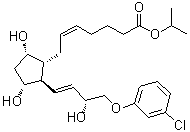
Cloprostenol isopropyl ester is also known as isopropyl cloprostenate. The short name identifies a terminal functional group: the carboxyl group of cloprostenol is esterified with an isopropyl group. The substituted cyclopentane framework and its stereochemistry remain important parts of the molecule. A product name that simply says prostaglandin analogue does not identify the ester or distinguish it from an amide.
A free carboxylic acid can ionize, whereas its corresponding ester masks that acid group. This can alter how the compound partitions between environments. Ester bonds may also be hydrolyzed, but the structure alone does not tell us the extent or rate of conversion in a particular formulation or tissue. A possible chemical reaction and a measured exposure are different kinds of evidence. In particular, properties of cloprostenol, another ester, or a related eye medicine should not be assigned automatically to this specific substance.
The European Scientific Committee on Consumer Safety addressed isopropyl cloprostenate in its evaluation of prostaglandin analogues used in cosmetics and revisited it in a 2026 opinion. The context included products used near eyelashes. It is a useful case for understanding why an appearance-related claim does not define the biological scope of exposure. The material contacts a region close to the eye, so assessment depends on both the molecule and the conditions under which a finished product would be used. Evaluation alone is not evidence of a safe concentration.
In its final opinion the committee did not consider the compound safe for the evaluated purpose of promoting eyelash and eyebrow growth. It pointed to pharmacological activity at low concentrations and to insufficient evidence to rule out potential reproductive or developmental effects. This is a safety assessment for the specified cosmetic use. It does not mean that an effect was demonstrated in every exposed person, and an expert opinion is distinct from the legal status of an ingredient in any particular jurisdiction.
Analytical identification is similarly specific. An analyst must distinguish the ester from its corresponding acid and from structurally related analogues. A signal shared across a chemical family cannot answer which analogue is present or how much was detected. For safety evaluation, the relevant starting point is the exact ingredient, supported by evidence for that identity and formulation rather than by a broad family resemblance.
References:
1. SCCS. Prostaglandins and prostaglandin analogues used in cosmetic products. https://health.ec.europa.eu/publications/prostaglandins-and-prostaglandin-analogues-used-cosmetic-products_en
2. SCCS. Opinion on MDN, IPCP and DDDE (2026). https://health.ec.europa.eu/publications/sccs-prostaglandin-analogues-methylamido-dihydro-noralfaprostal-mdn-isopropyl-cloprostenate-ipcp_en
|






 GHS07 Warning Details
 chemBlink Chemical Story