
Online Database of Chemicals from Around the World
| Shanghai Yeexin Biochem & Tech Co., Ltd. | China | |||
|---|---|---|---|---|
 | www.bioyeexin.com | |||
 | +86 (21) 5417-6788 +86 13671761800 | |||
 | +86 (21) 5417-7952 | |||
 | sales@bioyeexin.com | |||
 | QQ Chat | |||
| Chemical manufacturer since 2009 | ||||
| chemBlink Standard supplier since 2009 | ||||
| BOC Sciences | USA | |||
|---|---|---|---|---|
| www.bocsci.com | |||
| +1 (631) 485-4226 | |||
| +1 (631) 614-7828 | |||
| info@bocsci.com | |||
| Chemical manufacturer | ||||
| chemBlink Standard supplier since 2010 | ||||
| Creative Peptides | USA | |||
|---|---|---|---|---|
| www.creative-peptides.com | |||
| +1 (631) 624-4882 | |||
| +1 (631) 614-7828 | |||
| info@creative-peptides.com | |||
| Chemical manufacturer | ||||
| chemBlink Standard supplier since 2010 | ||||
| Hangzhou Leap Chem Co., Ltd. | China | |||
|---|---|---|---|---|
| www.leapchem.com | |||
| +86 (571) 8771-1850 | |||
| market19@leapchem.com | |||
| QQ Chat | |||
| Chemical manufacturer since 2006 | ||||
| chemBlink Standard supplier since 2015 | ||||
| Amadis Chemical Co., Ltd. | China | |||
|---|---|---|---|---|
| www.amadischem.com | |||
| +86 (571) 8992-5085 | |||
| +86 (571) 8992-5065 | |||
| sales@amadischem.com | |||
| Chemical manufacturer since 2010 | ||||
| chemBlink Standard supplier since 2015 | ||||
| Changzhou Jiuwu Chemical Co., Ltd. | China | |||
|---|---|---|---|---|
| www.jiuwuchem.com | |||
| +86 (519) 8512-1086 +86 13775162768 | |||
| +86 (519) 8512-5369 | |||
| info@jiuwuchem.cn | |||
| QQ Chat | |||
| Chemical manufacturer since 2009 | ||||
| chemBlink Standard supplier since 2023 | ||||
| AnaSpec, Inc. | USA | |||
|---|---|---|---|---|
| www.anaspec.com | |||
| +1 (800) 452-5530 | |||
| +1 (510) 791-9560 | |||
| service@anaspec.com | |||
| Chemical manufacturer | ||||
| Classification | Biochemical >> Amino acids and their derivatives >> Cysteine derivative |
|---|---|
| Name | N-Fmoc-S-trityl-L-homocysteine |
| Synonyms | Fmoc-Hcys(Trt)-OH; (S)-2-(((9H-fluoren-9-yl)methoxy)carbonylamino)-4-(tritylthio)butanoic acid |
| Molecular Structure | 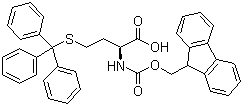 |
| Molecular Formula | C38H33NO4S |
| Molecular Weight | 599.74 |
| CAS Registry Number | 167015-23-8 |
| SMILES | C1=CC=C(C=C1)C(C2=CC=CC=C2)(C3=CC=CC=C3)SCC[C@@H](C(=O)O)NC(=O)OCC4C5=CC=CC=C5C6=CC=CC=C46 |
| Density | 1.3±0.1 g/cm3 Calc.* |
|---|---|
| Boiling point | 780.1±60.0 °C 760 mmHg (Calc.)* |
| Flash point | 425.6±32.9 °C (Calc.)* |
| Solubility | 1 mM in 2 mL DMF (Expl.) |
| Index of refraction | 1.649 (Calc.)* |
| * | Calculated using Advanced Chemistry Development (ACD/Labs) Software. |
| Hazard Symbols |  GHS07 Warning Details |
|---|---|
| Risk Statements | H302-H315-H319-H335 Details |
| Safety Statements | P261-P305+P351+P338 Details |
| SDS | Available |
 chemBlink Chemical Story
|
Sometimes the most useful atom in a synthesis is one that helps form a bond and is then chemically edited into its final role. N-Fmoc-S-trityl-L-homocysteine, CAS 167015-23-8, supports that idea in peptide chemistry. Its homocysteine core can provide a sulfur-containing handle for chemical ligation, while later sulfur methylation can create a methionine side chain. Homocysteine differs from cysteine by one extra methylene group between the alpha carbon and sulfur. Its side chain is CH2CH2SH rather than CH2SH. Methionine has the corresponding methyl thioether, CH2CH2SCH3. These relationships explain the synthetic opportunity: modifying sulfur can convert a homocysteine residue into a methionine residue without inserting another carbon into the peptide backbone. The material identified by this CAS is not free homocysteine. Fmoc protects its amino group, and trityl protects the thiol as an S-substituted derivative. These temporary groups help deliver the amino-acid unit through an appropriate assembly strategy. The sulfur must become available at the relevant later stage; an S-trityl-protected molecule does not present the same free-thiol reactivity while its protection remains intact. Native chemical ligation joins peptide fragments using a reaction between a suitable thioester and an amino-terminal thiol-containing residue, followed by rearrangement to an amide linkage. Homocysteine can serve in adaptations of this chemistry. The sulfur is not merely a spectator substituent: its temporary participation helps organize a path to joining the fragments. The final peptide bond and the initial sulfur-linked intermediate are distinct chemical states. In 2006, Saporito and colleagues reported chemical synthesis of the 63-residue bacterial GstI protein using ligation at an X-Met site. The work provides an example of a strategy involving homocysteine and subsequent conversion toward the methionine-containing product. Its relevance is access to a defined protein by chemical synthesis, not a claim that the protected amino-acid reagent itself reproduces that protein's function. The notation X-Met identifies the location of the final peptide bond relative to methionine; X stands for the preceding residue rather than a particular chemical element. This is useful because a protein sequence may offer a methionine position where a fragment junction is convenient. A temporary sulfur-based handle can expand the choices of where to divide a larger target into synthetic pieces. That expansion comes with selectivity questions. A larger peptide can contain other nucleophilic groups, sulfur atoms, and oxidation-sensitive sites. Transforming one residue does not guarantee that all other functions remain unchanged. Characterization must establish both successful fragment joining and the intended final side-chain identity. An expected mass is informative, but positional assignments and purity may require additional analytical evidence. Following the side-chain carbon atoms prevents a common misunderstanding of the editing step. The two methylenes of homocysteine remain between the backbone and sulfur, while the added methyl becomes attached beyond sulfur. It is not a methyl added to nitrogen, nor an extension of the backbone. This atom-by-atom relationship explains why the operation can create methionine rather than merely producing an unspecified methylated amino acid with a different substitution pattern. The story is therefore one of temporary reactivity followed by permanent editing. Fmoc and trityl help manage the building block, homocysteine supplies a useful intermediate side chain, and the finished molecule can contain methionine instead. This sequence illustrates how chemical protein synthesis can exploit a residue that is useful during construction even when a different residue is required in the final structure. References: 1. Bachem. Fmoc-Homocys(Trt)-OH, product 4025118; CAS 167015-23-8 and ligation application. https://shop.bachem.com/product/4025118/ 2. Saporito A et al. The chemical synthesis of the GstI protein by NCL on a X-Met site. Biopolymers (2006). https://doi.org/10.1002/bip.20582 |
| Market Analysis Reports |