
Online Database of Chemicals from Around the World
| Nonsensia | Poland | |||
|---|---|---|---|---|
 | nonsensia.pl | |||
 | +48 506 848 838 | |||
 | nonsensia@outlook.com | |||
| Chemical manufacturer since 2023 | ||||
| chemBlink Standard supplier since 2026 | ||||
| Classification | Organic raw materials >> Amino compound >> Amide compound |
|---|---|
| Name | N-(Adamantan-2-yl)-4-chlorobenzamide |
| Synonyms | N-(2-adamantyl)-4-chlorobenzamide |
| Molecular Structure | 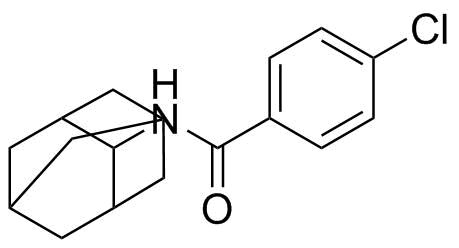 |
| Molecular Formula | C17H20ClNO |
| Molecular Weight | 289.8 |
| CAS Registry Number | 185384-80-9 |
| SMILES | C1C2CC3CC1CC(C2)C3NC(=O)C4=CC=C(C=C4)Cl |
 chemBlink Chemical Story
|
N-(Adamantan-2-yl)-4-chlorobenzamide, also called chlodantane, is an amide built from a rigid adamantane cage and a chlorinated aromatic group. The name specifies the attachment at carbon 2 of adamantane and the position of chlorine at carbon 4 of the benzamide ring. Those numbers matter. Changing the cage attachment from carbon 2 to carbon 1 would give a different constitutional isomer, even though the atom count stayed the same. Moving chlorine away from the para position would likewise produce another isomer. The amide puts a carbonyl group between the aromatic ring and the nitrogen that carries the cage. Bromantan provides a helpful contrast within the same batch of adamantane compounds. In bromantan the nitrogen joins an aromatic ring directly, with no carbonyl between them. Chlorine is also different from the bromine in bromantan. Comparing the drawings makes clear why a shared cage does not define the whole compound. Adding a carbonyl changes the arrangement of potential hydrogen-bonding sites, and amide resonance makes the nitrogen behave differently from that of an amine. A 1999 Russian-language publication discussed the compound together with other adamantane derivatives in the context of animal responses to physical or chemical stressors. The indexed abstract supports describing this as experimental work in animals. It does not provide a basis for claims about efficacy in people or establish an approved clinical indication. The compound is also documented as a reference material in a technical safety data sheet that pairs the structural name with the registry number. This independently helps establish which isomer the record is about. The available evidence therefore supports a focused description: a precisely named amide, a documented research reference context and a historical report in animals. A named reference material can help an analyst distinguish one isomer from its neighbors. That is a much narrower, and better documented, use than a claim about how the material would behave as a medicine. References: 1. ABX. Chlodantan safety data sheet, product 7046, revision 2022. https://crude.abx.de/api/public/document/byProduct/pdf/e68b8250-06a2-4131-b30a-c9bbbb35a959 2. Adamantane derivatives enhancing body's resistance to emergencies (1999). https://pubmed.ncbi.nlm.nih.gov/10222828/ |
| Market Analysis Reports |