
Online Database of Chemicals from Around the World
| Jiangsu Juming Chemical Technology Co., Ltd. | China | |||
|---|---|---|---|---|
 | en.jmchemchina.com | |||
 | +86 17798763151 | |||
 | admin@jumingchem.com | |||
| Chemical manufacturer since 2017 | ||||
| chemBlink Standard supplier since 2026 | ||||
| Classification | Organic raw materials >> Carboxylic compounds and derivatives |
|---|---|
| Name | 2,4,6-Trioxo-1,3,5-triazine-1,3,5(2H,4H,6H)-triacetic acid |
| Synonyms | 2-[3,5-bis(carboxymethyl)-2,4,6-trioxo-1,3,5-triazinan-1-yl]acetic acid |
| Molecular Structure | 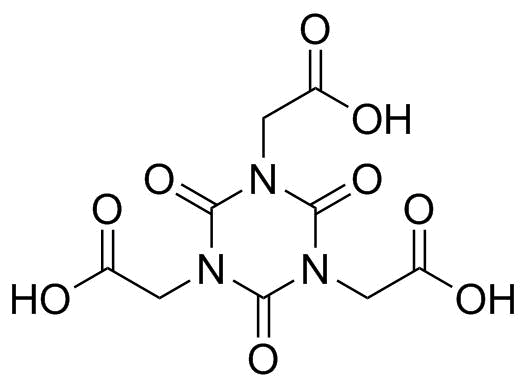 |
| Molecular Formula | C9H9N3O9 |
| Molecular Weight | 303.18 |
| CAS Registry Number | 1968-52-1 |
| SMILES | C(C(=O)O)N1C(=O)N(C(=O)N(C1=O)CC(=O)O)CC(=O)O |
| Hazard Symbols |   GHS05;GHS07 Danger Details GHS05;GHS07 Danger Details |
|---|---|
| Risk Statements | H315-H318-H335 Details |
| Safety Statements | P261-P264-P271-P280-P302+P352-P304+P340+P312-P305+P351+P338-P310-P332+P313-P362-P403+P233-P405-P501 Details |
| Transport Information | UN 3077 |
| SDS | Available |
 chemBlink Chemical Story
|
CAS 1968-52-1 is better known descriptively as tris(carboxymethyl) isocyanurate. Its architecture is unusually tidy: a rigid isocyanurate ring forms the center, and each of the three ring nitrogens carries a carboxymethyl arm. The result is a compact molecule with three carboxylic-acid groups arranged around a chemically robust triazine-trione core. That combination makes the compound interesting less as a finished product than as a multifunctional molecular connector. The isocyanurate ring is familiar in polymer and coating chemistry because isocyanurate structures are associated with thermally stable, highly crosslinked materials. In CAS 1968-52-1 the ring is already formed, so its role is not to trimerize during use but to hold three functional arms in a defined geometry. Each carboxyl group can form salts and can, under appropriate synthetic conditions, be converted into esters, amides or other derivatives. Three equivalent acid groups also create opportunities for coordination, surface interaction and network formation. A documented practical use appears in solder-flux technology. Patent literature on fluxes and solder pastes explicitly identifies tris(carboxymethyl) isocyanurate by CAS 1968-52-1 as one member of a family of carboxyalkyl isocyanurates. In those formulations, carboxylic-acid functionality helps remove or disrupt metal oxides that otherwise prevent molten solder from wetting a surface. The cited inventions report these isocyanurate carboxylic acids as components intended to improve solder wet spreadability. This application gives the molecule a useful contrast. Its central ring is relatively rigid and stable, but the peripheral carboxyl groups are chemically active toward the interfacial conditions encountered during soldering. Materials chemistry often depends on exactly this combination: a framework that survives processing while attached functional groups perform the desired chemical task. Public database records give the molecular formula C9H9N3O9 and molecular weight 303.18. PubChem also lists the systematic synonym 2,2',2''-(2,4,6-trioxo-1,3,5-triazinane-1,3,5-triyl)triacetic acid, which makes the threefold symmetry especially clear. The compound is therefore a good reminder that symmetry is not merely an aesthetic feature of a structural formula. Three similar functional arms attached to one rigid center can create predictable multivalent chemistry. Whether those arms are used for acid-base interactions, derivatization, coordination or oxide-removing flux action, the same molecular design principle remains: one stable hub can organize several reactive sites. References: 1. PubChem, 2,4,6-Trioxo-1,3,5-triazine-1,3,5-triacetic acid, CID 12558383. 2. EP3741498B1, Flux and solder paste. 3. EP4063061B1, Flux and solder paste. 4. CN113423850A, Flux and solder paste. |
| Market Analysis Reports |