
Online Database of Chemicals from Around the World
| BOC Sciences | USA | |||
|---|---|---|---|---|
 | www.bocsci.com | |||
 | +1 (631) 485-4226 | |||
 | +1 (631) 614-7828 | |||
 | info@bocsci.com | |||
| Chemical manufacturer | ||||
| chemBlink Standard supplier since 2010 | ||||
| Creative Peptides | USA | |||
|---|---|---|---|---|
| www.creative-peptides.com | |||
| +1 (631) 624-4882 | |||
| +1 (631) 614-7828 | |||
| info@creative-peptides.com | |||
| Chemical manufacturer | ||||
| chemBlink Standard supplier since 2010 | ||||
| Hangzhou Qichuang Chemical Co., Ltd. | China | |||
|---|---|---|---|---|
| www.qc-chemical.com | |||
| +86 (571) 8893-5129 | |||
| +86 (571) 8825-0182 | |||
| david@qc-chemical.com sales@qc-chemical.com davidw0828@gmail.com | |||
 | QQ Chat | |||
| Chemical distributor since 2009 | ||||
| chemBlink Standard supplier since 2013 | ||||
| Avantpbc Chemical Tech(Shanghai) Ltd. | China | |||
|---|---|---|---|---|
| www.avantpbc.com | |||
| +86 17802107445 | |||
| info@avantpbc.com | |||
| Chemical manufacturer since 2015 | ||||
| chemBlink Standard supplier since 2016 | ||||
| Zhejiang Peptites Biotech Co., Ltd. | China | |||
|---|---|---|---|---|
| www.peptide-china.com | |||
| +86 18846050901 | |||
| fangjun@peptide-china.com | |||
| Chemical manufacturer since 2014 | ||||
| chemBlink Standard supplier since 2019 | ||||
| Neostar United (Changzhou) Industrial Co., Ltd. | China | |||
|---|---|---|---|---|
| www.neostarunited.com | |||
| +86 (519) 8555-7386 +86 18015025600 | |||
| +86 (519) 8555-7389 | |||
| marketing1@neostarunited.com | |||
| Chemical distributor since 2014 | ||||
| chemBlink Standard supplier since 2020 | ||||
| Ningbo Kilo Biotechnology Co., Ltd. | China | |||
|---|---|---|---|---|
| www.kilobio.com | |||
| +8613989352104 | |||
| terry.zhang@kilobio.com | |||
| QQ Chat | |||
 | WeChat: Wenzhou Medical University | |||
| Chemical distributor since 2023 | ||||
| chemBlink Standard supplier since 2023 | ||||
| Classification | API >> Hormone and endocrine-regulating drugs |
|---|---|
| Name | Teduglutide |
| Synonyms | Gattex; Glucagon-like peptide II [2-glycine] (human); ALX 0600 |
| Molecular Structure | 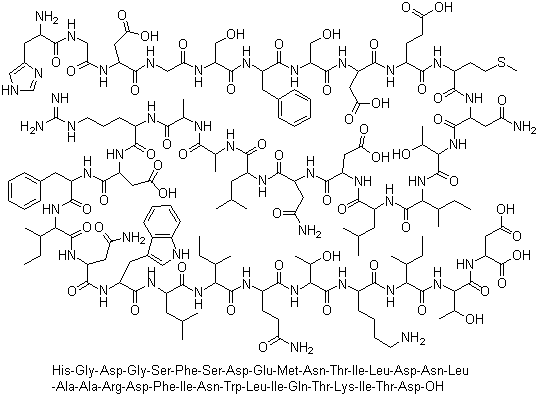 |
| Molecular Formula | C164H252N44O55S |
| Molecular Weight | 3752.13 |
| CAS Registry Number | 197922-42-2 |
| EC Number | 812-261-5 |
| SMILES | CC[C@H](C)[C@@H](C(=O)N[C@@H]([C@@H](C)O)C(=O)N[C@@H](CC(=O)O)C(=O)O)NC(=O)[C@H](CCCCN)NC(=O)[C@H]([C@@H](C)O)NC(=O)[C@H](CCC(=O)N)NC(=O)[C@H]([C@@H](C)CC)NC(=O)[C@H](CC(C)C)NC(=O)[C@H](CC1=CNC2=CC=CC=C21)NC(=O)[C@H](CC(=O)N)NC(=O)[C@H]([C@@H](C)CC)NC(=O)[C@H](CC3=CC=CC=C3)NC(=O)[C@H](CC(=O)O)NC(=O)[C@H](CCCNC(=N)N)NC(=O)[C@H](C)NC(=O)[C@H](C)NC(=O)[C@H](CC(C)C)NC(=O)[C@H](CC(=O)N)NC(=O)[C@H](CC(=O)O)NC(=O)[C@H](CC(C)C)NC(=O)[C@H]([C@@H](C)CC)NC(=O)[C@H]([C@@H](C)O)NC(=O)[C@H](CC(=O)N)NC(=O)[C@H](CCSC)NC(=O)[C@H](CCC(=O)O)NC(=O)[C@H](CC(=O)O)NC(=O)[C@H](CO)NC(=O)[C@H](CC4=CC=CC=C4)NC(=O)[C@H](CO)NC(=O)CNC(=O)[C@H](CC(=O)O)NC(=O)CNC(=O)[C@H](CC5=CN=CN5)N |
 chemBlink Chemical Story
|
Teduglutide shows how changing one amino acid can change the lifetime of a peptide signal. It is an analogue of human glucagon-like peptide-2, or GLP-2. It is not a GLP-1 analogue: the similar names refer to related peptides with different receptors and roles. GLP-2 signaling is associated with intestinal function, which is why teduglutide was developed in the context of short bowel syndrome rather than as an appetite treatment. At position two, teduglutide contains glycine instead of the alanine present in native GLP-2. Glycine has hydrogen in place of alanine's methyl side chain. This small change reduces susceptibility to cleavage by dipeptidyl peptidase-4, an enzyme that recognizes features near the amino terminus. The peptide retains the overall sequence needed for the intended receptor activity while becoming more resistant to one route of inactivation. Resistance to one enzyme is not the same as indefinite persistence or resistance to every form of breakdown. The clinical question is practical. After extensive loss of functional intestine, some people cannot absorb enough fluid and nutrients to meet their needs without support given outside the digestive tract. The question in a controlled study was whether teduglutide could reduce that support in participants with short bowel syndrome and intestinal failure. The investigators reported a reduction in the need for parenteral support. The endpoint concerns the volume of support required under the trial's conditions; it is not a claim that the peptide reconstructs all of the intestine that was lost. A response in this setting has to be interpreted with attention to fluid balance. Improved absorption can change how much externally supplied fluid is needed. A fixed amount of support is not necessarily appropriate if absorption changes. This explains why clinical evaluation includes changes in support requirements and safety monitoring rather than relying only on a molecular explanation. The drug label describes a defined indication and significant monitoring considerations; those are properties of an evaluated medicine, not claims about materials sold under a matching chemical name. A useful endpoint must reflect the practical burden of the condition. Someone may require both nutrients and fluids, and those needs may not fall in parallel. In a trial, a reduction in weekly support volume provides a reproducible measure of change. It does not mean that every participant could stop support, and an average or a group comparison cannot tell what would happen to an individual. Reading the endpoint in its original units helps preserve this distinction. The name of the enzyme also explains the importance of the position of the substitution. Dipeptidyl peptidase-4 removes a pair of residues from a susceptible amino terminus. Placing the change in the second residue modifies the region that the enzyme recognizes. This is not the same strategy as attaching an external carrier or hiding the whole peptide inside a formulation. The structural change is part of the active peptide itself, making its exact sequence important to the description of the medicine. The example also shows why sequence and clinical endpoint belong in the same story. The sequence change answers a question about recognition by an enzyme. Receptor activity answers a second question about the kind of signal the peptide can provide. A controlled trial addresses a third question, whether the intervention changes a measurable need in people with a particular condition. Neither the stability of the peptide nor receptor activation alone answers that last question. References: 1. Jeppesen PB et al. Dipeptidyl peptidase IV resistant GLP-2 analogue. Gut (2005). https://doi.org/10.1136/gut.2004.061440 2. DailyMed. GATTEX prescribing information. https://www.dailymed.nlm.nih.gov/dailymed/drugInfo.cfm?setid=66b69c1e-b25c-44d3-b5ff-1c1de9a516fa 3. Jeppesen PB et al. Teduglutide and parenteral support in short bowel syndrome. Gastroenterology (2012). https://pubmed.ncbi.nlm.nih.gov/22982184/ |
| Market Analysis Reports |