
Online Database of Chemicals from Around the World
| Simagchem Corporation | China | |||
|---|---|---|---|---|
 | www.simagchem.com | |||
 | +86 13806087780 | |||
 | +86 (592) 268-0237 | |||
 | sale@simagchem.com | |||
| Chemical manufacturer since 2002 | ||||
| chemBlink Standard supplier since 2008 | ||||
| Discovery Fine Chemicals Ltd. | UK | |||
|---|---|---|---|---|
| www.discofinechem.com | |||
| +44 (1202) 874-517 | |||
| +44 (845) 094-4385 | |||
| pjc@discofinechem.com | |||
| Chemical manufacturer | ||||
| chemBlink Standard supplier since 2009 | ||||
| Hefei TNJ Chemical Industry Co., Ltd. | China | |||
|---|---|---|---|---|
| www.tnjchem.com | |||
| +86 (551) 6541-8684 | |||
| +86 (551) 6541-8697 | |||
| sales@tnjchem.com | |||
| Chemical manufacturer since 2001 | ||||
| chemBlink Standard supplier since 2010 | ||||
| Zhangjiagang Specom Biochemical Co., Ltd. | China | |||
|---|---|---|---|---|
| www.spbiochem.com | |||
| +86 (512) 5899-2291 5899-2287 | |||
| +86 (512) 5899-2285 | |||
| sales@spbiochem.com | |||
 | QQ Chat | |||
| Chemical manufacturer since 2010 | ||||
| chemBlink Standard supplier since 2010 | ||||
| BOC Sciences | USA | |||
|---|---|---|---|---|
| www.bocsci.com | |||
| +1 (631) 485-4226 | |||
| +1 (631) 614-7828 | |||
| info@bocsci.com | |||
| Chemical manufacturer | ||||
| chemBlink Standard supplier since 2010 | ||||
| LEAPChem | China | |||
|---|---|---|---|---|
| www.leapchem.com | |||
| +86 (571) 8771-1850 | |||
| market19@leapchem.com | |||
| QQ Chat | |||
| Chemical manufacturer since 2006 | ||||
| chemBlink Standard supplier since 2015 | ||||
| Hangzhou Kaixin Technology Co., Ltd. | China | |||
|---|---|---|---|---|
| www.hzkaixin.com | |||
| +86 (571) 8653-9527 | |||
| info@hzkaixin.com | |||
| Chemical distributor since 2017 | ||||
| chemBlink Standard supplier since 2019 | ||||
| Neostar United (Changzhou) Industrial Co., Ltd. | China | |||
|---|---|---|---|---|
| www.neostarunited.com | |||
| +86 (519) 8555-7386 +86 18015025600 | |||
| +86 (519) 8555-7389 | |||
| marketing1@neostarunited.com | |||
| Chemical distributor since 2014 | ||||
| chemBlink Standard supplier since 2020 | ||||
| Nutrition BioTech USA Inc. | USA | |||
|---|---|---|---|---|
| www.naturalbestbio.com | |||
| +1 (909) 745-1357 | |||
| sales@naturalbestbio.com | |||
| Chemical manufacturer since 2024 | ||||
| chemBlink Standard supplier since 2026 | ||||
| Chemos GmbH & Co. KG | Germany | |||
|---|---|---|---|---|
| www.chemos.de | |||
| +49 871-966346-0 | |||
| +49 871-966346-13 | |||
| chemos@chemos.de | |||
| Chemical distributor | ||||
| Wuhan Amino Acid Bio-Chemical Co., Ltd. | China | |||
|---|---|---|---|---|
| www.aaa-amino.com | |||
| +86 (27) 8447-2566 8429-7465 8429-7730 | |||
| +86 (27) 8429-7760 / 8429-7465 | |||
| amino@aaa-amino.com | |||
| Chemical manufacturer | ||||
| Classification | Biochemical >> Amino acids and their derivatives >> Other amino acid derivatives |
|---|---|
| Name | Magnesium dihydrogen di-L-aspartate |
| Synonyms | L-Aspartic acid magnesium salt; Magnesium (3S)-3-amino-4-hydroxy-4-oxobutanoate |
| Molecular Structure | 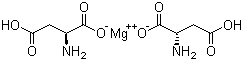 |
| Molecular Formula | 2(C4H6NO4).Mg |
| Molecular Weight | 288.49 |
| CAS Registry Number | 2068-80-6 |
| EC Number | 218-191-6 |
| SMILES | O=C([O-])C[C@H](N)C(O)=O.O=C([O-])C[C@H](N)C(O)=O.[Mg+2] |
| Hazard Symbols |  GHS07 Warning Details | ||||||||
|---|---|---|---|---|---|---|---|---|---|
| Risk Statements | H315-H319-H335 Details | ||||||||
| Safety Statements | P233-P260-P261-P264-P271-P280-P302+P352-P304-P304+P340-P305+P351+P338-P312-P332+P313-P337+P313-P340-P362-P403-P403+P233-P405-P501 Details | ||||||||
| Hazard Classification | |||||||||
| |||||||||
| SDS | Available | ||||||||
 chemBlink Chemical Story
|
The name magnesium dihydrogen di-L-aspartate encodes details that the shorter expression magnesium aspartate can hide. The registry entry specifies two L-aspartic acid residues per magnesium. Aspartic acid has a carboxyl group next to its amino-bearing carbon and a second carboxyl group on the side chain. It is therefore able to lose protons at more than one site. In simple charge bookkeeping for this salt, two singly charged hydrogen aspartate anions balance one Mg²⁺ ion. The L designation identifies the amino acid configuration. These facts do not settle the detailed coordination geometry of a particular crystal. Magnesium has a strong affinity for oxygen donors, including water and carboxylate groups. Descriptions of salts in terms of ions and ratios remain useful even when coordination in a solid is more complicated than the formula suggests. After dissolution the distribution of species can depend on pH, concentration and competing ligands. Neither the recipe for the dry material nor a simplified database diagram means that a single intact coordination complex will remain unchanged in every solution. A material's water content adds another distinction: hydrated and anhydrous material can deliver different amounts of magnesium per gram. The salt is relevant to comparisons among magnesium sources. In a small human study, Firoz and Graber compared commercial preparations using urinary magnesium excretion as an indicator. Magnesium aspartate, chloride and lactate preparations performed better than the oxide preparation under the study conditions. The NIH Office of Dietary Supplements places that result within a wider pattern in which forms that dissolve more readily are generally absorbed more fully. This was a comparison of preparations and an absorption proxy, not evidence that magnesium aspartate has a unique therapeutic effect. The practical unit when comparing labels is elemental magnesium. The entire salt includes the mass of two organic partners and, where present, water. An equivalent amount of a different salt may therefore weigh much more or less even when the elemental amount is identical. Keeping the registry identity, the product formulation and the measured outcome separate makes this familiar mineral easier to discuss precisely. References: 1. PubChem, L-aspartic acid magnesium salt (2:1), CID 57488534. https://pubchem.ncbi.nlm.nih.gov/compound/2068-80-6 2. Firoz M, Graber M. Bioavailability of US commercial magnesium preparations. Magnes Res. 2001;14:257–262. https://pubmed.ncbi.nlm.nih.gov/11794633/ 3. NIH Office of Dietary Supplements. Magnesium: fact sheet for health professionals. https://ods.od.nih.gov/factsheets/Magnesium-HealthProfessional/ |
| Market Analysis Reports |