Vitamin E began not as an antioxidant supplement but as a biological mystery. In 1922 Herbert Evans and Katharine Bishop reported that rats fed an otherwise adequate purified diet could grow normally yet fail to reproduce. Adding certain natural foods restored fertility. The unknown dietary factor was eventually called vitamin E, and in 1936 Evans and coworkers isolated alpha-tocopherol from wheat-germ oil. The name tocopherol was built from Greek roots associated with childbirth and bearing, preserving the circumstances of its discovery in the molecule's name.
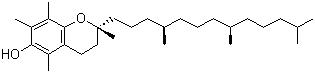
Vitamin E is not a single molecule but a family of tocopherols and tocotrienols. Alpha-tocopherol became the best-known member because animal and human physiology selectively retains it through the hepatic alpha-tocopherol transfer protein. Its chromanol head group can donate hydrogen to lipid peroxyl radicals, while its hydrophobic phytyl tail keeps the molecule embedded in membranes and lipoproteins. This architecture places the reactive antioxidant group exactly where polyunsaturated lipids are vulnerable to chain oxidation.
That membrane location explains the classic antioxidant model. Lipid peroxidation is a chain reaction: one radical attack can generate a lipid peroxyl radical that attacks another lipid. Alpha-tocopherol can interrupt the chain by donating a hydrogen atom and forming a comparatively stable tocopheroxyl radical. Other reducing systems can help return oxidized tocopherol toward its reduced state. The chemistry is elegant, but modern vitamin E biology is broader than the simple label "radical scavenger." Reviews now discuss effects on membrane organization, enzyme activity, signaling, gene expression, and the metabolism of tocopherol products.
The history also warns against assuming that more antioxidant is automatically better. Vitamin E deficiency is real and can have neurological and hematological consequences, particularly when fat absorption or lipoprotein handling is impaired. Yet large supplementation trials have not shown that high doses prevent every chronic disease once attributed to oxidative stress. The biological effect depends on dose, nutritional status, isoform, metabolism, and disease context. That distinction between an essential nutrient and a universal pharmacological cure is one of the most important lessons from a century of vitamin E research.
A further distinction is important when the label says "vitamin E." Natural sources contain several tocopherols and tocotrienols, while supplements may contain natural-source RRR-alpha-tocopherol or synthetic stereoisomer mixtures. International units and milligram amounts therefore cannot always be compared without knowing chemical form. The liver's stereoselective handling of alpha-tocopherol is one reason nutritional activity is not determined simply by total antioxidant capacity in a test tube. Chemical identity, stereochemistry, transport proteins, and metabolism all participate in deciding biological potency.
Vitamin E therefore matters for two reasons. Chemically, it is a beautifully positioned chain-breaking antioxidant in lipid environments. Historically, it shows how nutritional science moved from deficiency experiments to molecular isolation, synthesis, membrane chemistry, and modern signaling biology. The compound discovered because rats could not reproduce became a model for a larger question: how can a small, fat-soluble molecule protect and regulate the complex lipid structures on which cells depend?
References:
1. Evans HM, Bishop KS. Science. 1922;56:650-651. DOI: 10.1126/science.56.1458.650.
2. Evans HM, Emerson OH, Emerson GA. Journal of Biological Chemistry. 1936;113:319-332. DOI: 10.1016/S0021-9258(18)74918-1.
3. Azzi A. Free Radical Biology and Medicine. 2021;177:381-390. DOI: 10.1016/j.freeradbiomed.2021.10.029.
4. Muller L. European Journal of Organic Chemistry. 2022. DOI: 10.1002/ejoc.202201190.
|







 chemBlink Chemical Story