
Online Database of Chemicals from Around the World
| Sinocompound Catalysts Co., Ltd. | China | |||
|---|---|---|---|---|
 | www.sinocompound.com | |||
 | +86 (512) 6721-6630 | |||
 | +86 (512) 5631-6689 | |||
 | sales@sinocompound.com | |||
| Chemical manufacturer since 2008 | ||||
| chemBlink Standard supplier since 2010 | ||||
| SL Drugs and Pharmaceuticals Pvt. Ltd. | India | |||
|---|---|---|---|---|
| www.sldrugs.com | |||
| +91 (40) 6661-1133 | |||
| +91 (40) 2375-1130 | |||
| enquiry@sldrugs.com | |||
| Chemical distributor since 1999 | ||||
| chemBlink Standard supplier since 2010 | ||||
| BOC Sciences | USA | |||
|---|---|---|---|---|
| www.bocsci.com | |||
| +1 (631) 485-4226 | |||
| +1 (631) 614-7828 | |||
| info@bocsci.com | |||
| Chemical manufacturer | ||||
| chemBlink Standard supplier since 2010 | ||||
| Shanghai Coachchem | China | |||
|---|---|---|---|---|
| www.coachchem.com | |||
| +86 (21) 6048-3766 6048-3768 | |||
| +86 (21) 3721-1720 | |||
| marketing@coachchem.com wujingxuan110202@hotmail.com | |||
| Chemical manufacturer since 2011 | ||||
| chemBlink Standard supplier since 2011 | ||||
| Shanghai Scientia Pharmaceutical Technology Co., Ltd. | China | |||
|---|---|---|---|---|
| www.scientiapharm.net | |||
| +86 (21) 5430-1573 6172-1573 400-036-1573 | |||
| +86 (21) 5186-1981 | |||
| sales@scientiapharm.com scientiapharm@gmail.com | |||
 | QQ Chat | |||
| Chemical manufacturer since 2009 | ||||
| chemBlink Standard supplier since 2012 | ||||
| Hangzhou Leap Chem Co., Ltd. | China | |||
|---|---|---|---|---|
| www.leapchem.com | |||
| +86 (571) 8771-1850 | |||
| market19@leapchem.com | |||
| QQ Chat | |||
| Chemical manufacturer since 2006 | ||||
| chemBlink Standard supplier since 2015 | ||||
| Sphinx Scientific Laboratory (Tianjin) Co., Ltd. | China | |||
|---|---|---|---|---|
| www.sphinxpharm.com | |||
| +86 (22) 6621-1289 ex 818 | |||
| +86 (22) 6621-1370 | |||
| lilh@sphinxpharm.com | |||
| QQ Chat | |||
| Chemical manufacturer since 2009 | ||||
| chemBlink Standard supplier since 2017 | ||||
| Wonderchem Co., Limited | Hong Kong | |||
|---|---|---|---|---|
| www.wonder-chem.com | |||
| +852 8192-5218 | |||
| sales@wonder-chem.com | |||
| Chemical distributor since 2016 | ||||
| chemBlink Standard supplier since 2017 | ||||
| Ningbo Kilo Biotechnology Co., Ltd. | China | |||
|---|---|---|---|---|
| www.kilobio.com | |||
| +8613989352104 | |||
| terry.zhang@kilobio.com | |||
| QQ Chat | |||
 | WeChat: Wenzhou Medical University | |||
| Chemical distributor since 2023 | ||||
| chemBlink Standard supplier since 2023 | ||||
| DeLong Chemicals America | USA | |||
|---|---|---|---|---|
| www.delongchemicals.com | |||
| +1 (203) 271-9017 | |||
| sales@delongchemicals.com | |||
| Chemical manufacturer | ||||
| Classification | Chemical reagent >> Organic reagent >> Phosphine ligand |
|---|---|
| Name | Grubbs Catalyst 2nd Generation |
| Synonyms | 1,3-Bis(2,4,6-trimethylphenyl)-2-(imidazolidinylidene)(dichlorophenylmethylene)(tricyclohexylphosphine)ruthenium |
| Molecular Structure | 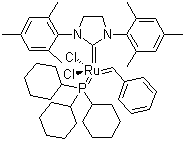 |
| Molecular Formula | C46H65Cl2N2PRu |
| Molecular Weight | 848.97 |
| CAS Registry Number | 246047-72-3 |
| EC Number | 688-322-3 |
| SMILES | CC1=CC(=C(C(=C1)C)N2CCN(C2=[Ru](=CC3=CC=CC=C3)(Cl)Cl)C4=C(C=C(C=C4C)C)C)C.C1CCC(CC1)P(C2CCCCC2)C3CCCCC3 |
| Melting point | 143.5 - 148.5 °C (Expl.) |
|---|---|
| Hazard Symbols |  GHS02 Danger Details | ||||||||
|---|---|---|---|---|---|---|---|---|---|
| Risk Statements | H228 Details | ||||||||
| Safety Statements | P210-P240-P241-P280-P370+P378 Details | ||||||||
| Hazard Classification | |||||||||
| |||||||||
| Transport Information | UN 1325 | ||||||||
| SDS | Available | ||||||||
 chemBlink Chemical Story
|
Second-generation Grubbs catalyst is a ruthenium benzylidene complex used in olefin metathesis. The term benzylidene identifies the carbon fragment attached to ruthenium through a metal-carbon double bond. The term metathesis identifies the transformation: fragments associated with carbon-carbon double bonds exchange partners. Atoms are rearranged into new connectivity rather than simply added across an alkene to consume its unsaturation. The second generation retains a phosphine but replaces the other phosphine of the familiar first-generation complex with a saturated N-heterocyclic carbene ligand. This ligand is coordinated through carbon and is distinct from the benzylidene group that participates in the metathesis cycle. Naming both pieces matters because the word carbene can otherwise suggest that all metal-carbon bonds in the catalyst serve the same purpose. The supporting ligand changes the electronic environment of ruthenium; the alkylidene is the fragment that changes as the reaction proceeds. In 1999, Scholl and colleagues reported a new family of ruthenium catalysts containing the saturated carbene ligand. Their work addressed a practical problem: how to improve metathesis activity while retaining the utility of a well-defined metal complex. The consequence of the ligand change is not that every substrate reacts under identical conditions. Formation of the active species, interaction with the alkene and turnover can differ from one substrate to another. A precatalyst's structure and the species actually present during a reaction are related, but not identical. A helpful picture of the cycle begins with a metal alkylidene and an alkene. They can form a four-membered intermediate containing ruthenium and three carbon atoms. Fragmentation in a different direction gives a new alkene and a changed metal alkylidene. Because the metal can go through the cycle repeatedly, the catalyst can mediate more than one exchange. This model explains the rearrangement of partners while accounting for the propagation of a catalytic species. Different applications ask for different outcomes from the same type of bond exchange. When both alkene groups belong to one molecule, metathesis can link them into a ring. If suitable alkene groups are on different molecules, exchange can change how those pieces connect. In ring-opening metathesis polymerization, a strained cyclic alkene provides a path for chain growth. Those outcomes cannot be predicted from the catalyst name alone; the substrate architecture is central to what product can form. Ring closing and ring opening may sound like opposite jobs for a single catalyst. The apparent contradiction disappears when the exchange is followed one bond at a time. In a ring-closing example, the positions of the participating double bonds allow part of a chain to become cyclic. In polymerization, a cyclic starting unit can become part of an extending chain. The starting material supplies the geometric opportunity, and in the latter case ring strain can provide a driving force. The same catalytic logic therefore connects small-molecule synthesis with materials chemistry, from making an individual ring to assembling a chain of repeating units. The 2005 Nobel Prize in Chemistry recognized the development of metathesis in organic synthesis. The second-generation catalyst is one example of that broader development, not the whole discovery. Its distinctive lesson is that changes to a ligand retained near the metal can change what a catalytic cycle can accomplish, without changing the class of bond exchange that defines the reaction. This makes the complex a concrete example of how coordination chemistry reshapes the possibilities for assembling carbon frameworks. References: 1. Scholl M et al. Ruthenium metathesis catalysts with dihydroimidazolylidene ligands. Org Lett (1999). https://doi.org/10.1021/ol990909q 2. Nobel Prize in Chemistry 2005. Scientific background and award. https://www.nobelprize.org/prizes/chemistry/2005/summary/ 3. Merck. Aldrichimica Acta 35, metathesis catalyst identities. https://www.merckmillipore.com/deepweb/assets/sigmaaldrich/marketing/global/documents/403/862/acta-vol35.pdf |
| Market Analysis Reports |