
Online Database of Chemicals from Around the World
| Simagchem Corporation | China | |||
|---|---|---|---|---|
 | www.simagchem.com | |||
 | +86 13806087780 | |||
 | +86 (592) 268-0237 | |||
 | sale@simagchem.com | |||
| Chemical manufacturer since 2002 | ||||
| chemBlink Standard supplier since 2008 | ||||
| Hefei TNJ Chemical Industry Co., Ltd. | China | |||
|---|---|---|---|---|
| www.tnjchem.com | |||
| +86 (551) 6541-8684 | |||
| +86 (551) 6541-8697 | |||
| sales@tnjchem.com | |||
| Chemical manufacturer since 2001 | ||||
| chemBlink Standard supplier since 2010 | ||||
| BOC Sciences | USA | |||
|---|---|---|---|---|
| www.bocsci.com | |||
| +1 (631) 485-4226 | |||
| +1 (631) 614-7828 | |||
| info@bocsci.com | |||
| Chemical manufacturer | ||||
| chemBlink Standard supplier since 2010 | ||||
| Shanghai Hanjing Chemicals Co., Ltd. | China | |||
|---|---|---|---|---|
| www.hanjingchemicals.com | |||
| +86 (21) 3700-9251 3700-9252 | |||
| +86 (21) 3700-9253 | |||
| jack.xue@hanjinggroup.com jackxue1976@hotmail.com | |||
| Chemical manufacturer | ||||
| chemBlink Standard supplier since 2011 | ||||
| Taizhou Tongxin Biopharmaceutical Technology Co., Ltd. | China | |||
|---|---|---|---|---|
| www.allyrise.com | |||
| +86 18652728585 | |||
| +86 (523) 8276-5215 | |||
| sales@allyrise.com | |||
 | QQ Chat | |||
| Chemical manufacturer since 2013 | ||||
| chemBlink Standard supplier since 2013 | ||||
| wuhan chemi Pharmacy Chemical Technology Co., Ltd. | China | |||
|---|---|---|---|---|
| www.chemipharm.com.cn | |||
| +86 13971619949 | |||
| gmn424@chemipharm.com.cn | |||
| QQ Chat | |||
 | WeChat: 13971619949 | |||
| Chemical manufacturer since 2014 | ||||
| chemBlink Standard supplier since 2026 | ||||
| Classification | Chemical reagent >> Organic reagent >> Oxime |
|---|---|
| Name | Butyramidine hydrochloride |
| Molecular Structure | 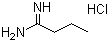 |
| Molecular Formula | C4H11ClN2 |
| Molecular Weight | 122.60 |
| CAS Registry Number | 3020-81-3 |
| EC Number | 818-226-0 |
| SMILES | CCCC(=N)N.Cl |
| Hazard Symbols |  GHS07 Warning Details GHS07 Warning Details | ||||||||
|---|---|---|---|---|---|---|---|---|---|
| Risk Statements | H315-H319-H335 Details | ||||||||
| Safety Statements | P261-P264-P264+P265-P271-P280-P302+P352-P304+P340-P305+P351+P338-P319-P321-P332+P317-P337+P317-P362+P364-P403+P233-P405-P501 Details | ||||||||
| Hazard Classification | |||||||||
| |||||||||
| SDS | Available | ||||||||
 chemBlink Chemical Story
|
Butyramidine hydrochloride is the hydrochloride salt form of butyramidine, an amidine-containing organic compound derived from butyric acid through functional group transformation into an amidine moiety. Amidine functional groups are characterized by a carbon–nitrogen double bond system with resonance stabilization between two nitrogen atoms, giving these compounds strongly basic and highly polar properties. The chemistry of amidines has been widely studied in organic and medicinal chemistry due to their unique combination of basicity and hydrogen-bonding ability. Unlike amides, amidines are significantly more basic because protonation occurs preferentially at nitrogen, producing stable amidinium ions. This property makes amidine-containing compounds useful in biological systems, proton-transfer chemistry, and as intermediates in synthetic transformations. In butyramidine hydrochloride, the presence of hydrochloric acid leads to protonation of the amidine functional group, forming an amidinium chloride salt. This protonated form enhances water solubility and stabilizes the compound in solid form. Salt formation with hydrochloric acid is a common strategy in organic chemistry to isolate and handle basic nitrogen-containing compounds, particularly those that are volatile or sensitive in their free-base form. The butyryl backbone in butyramidine corresponds to a four-carbon aliphatic chain, which provides a flexible hydrophobic framework. This hydrocarbon chain is relatively nonpolar compared with the highly polar amidinium group, resulting in an amphiphilic balance between hydrophobic and hydrophilic regions in the molecule. The overall physicochemical properties are therefore strongly influenced by the charged amidinium functionality. Amidines are known to participate in extensive hydrogen bonding due to the presence of both hydrogen bond donors and acceptors. In the protonated amidinium form, the positive charge is delocalized across the nitrogen atoms, increasing the stability of hydrogen-bonded networks. This contributes to high melting points and strong crystalline lattice formation in many amidine hydrochloride salts. From a structural perspective, the amidine group can be represented by resonance forms in which the positive charge is distributed between the two nitrogen atoms. This delocalization stabilizes the protonated species and influences its reactivity in both acid–base chemistry and nucleophilic substitution reactions. The carbon–nitrogen bond system in amidines is also more rigid than that of simple amines, which can affect molecular conformation and binding interactions. Butyramidine hydrochloride is typically encountered as a synthetic intermediate or reagent in organic chemistry rather than as a final bioactive compound. Amidine-containing structures are commonly used in the synthesis of heterocycles, pharmaceuticals, and functional materials due to their strong basicity and ability to form stable salts. They can also serve as precursors for the construction of nitrogen-rich heterocyclic systems through cyclization reactions. In aqueous solution, butyramidine hydrochloride is expected to be highly soluble due to its ionic nature. The protonated amidinium group interacts strongly with water molecules through electrostatic interactions and hydrogen bonding. The aliphatic chain contributes limited hydrophobic character but does not significantly reduce overall solubility. The synthesis of amidines, including butyramidine derivatives, is often achieved through reactions of nitriles with ammonia or amines under acidic or catalytic conditions, or through Pinner-type reactions involving imidate intermediates. Subsequent treatment with hydrochloric acid yields the corresponding stable salt form. Overall, butyramidine hydrochloride is a protonated amidine salt characterized by a strongly basic amidinium functional group and a short aliphatic chain. Its significance lies in its high polarity, strong hydrogen-bonding capacity, and utility as a reactive intermediate in organic synthesis and nitrogen-containing compound preparation. References 2014. [Antioxidant properties of conjugates of polyethylene glycols, having a terpenophenolic fragments]. Bioorganicheskaia khimiia. PMID: 25898726 |
| Market Analysis Reports |