
Online Database of Chemicals from Around the World
| Yancheng Langde Chemical & Pharmaceutical Co., Ltd. | China | |||
|---|---|---|---|---|
 | www.langdechem.com | |||
 | +86 (515) 8835-9955 +86 13705103058 | |||
 | +86 (515) 8835-7955 | |||
 | langdechem@163.com | |||
 | QQ Chat | |||
| Chemical manufacturer since 2006 | ||||
| chemBlink Standard supplier since 2006 | ||||
| Tyger Scientific Inc. | USA | |||
|---|---|---|---|---|
| www.tygersci.com | |||
| +1 (609) 434-0144 | |||
| +1 (609) 434-0143 | |||
| sales@tygersci.com | |||
| Chemical manufacturer since 1992 | ||||
| chemBlink Standard supplier since 2008 | ||||
| Hubei Yihua New Materials Technology Co., Ltd. | China | |||
|---|---|---|---|---|
| yianchem.com | |||
| +44 07892 880081 | |||
| contact@yianchem.com | |||
 | WhatsApp:+44 07892 880081 | |||
| Chemical distributor since 2025 | ||||
| chemBlink Standard supplier since 2026 | ||||
| AK Scientific, Inc | USA | |||
|---|---|---|---|---|
| www.aksci.com | |||
| +1 (510) 429-8835 | |||
| +1 (510) 429-8836 | |||
| sales@aksci.com | |||
| Chemical manufacturer | ||||
| Classification | Chemical reagent >> Organic reagent >> Alkyne |
|---|---|
| Name | 3-Nitrophenylacetylene |
| Synonyms | 1-Ethynyl-3-nitrobenzene |
| Molecular Structure | 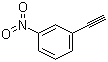 |
| Molecular Formula | C8H5NO2 |
| Molecular Weight | 147.13 |
| CAS Registry Number | 3034-94-4 |
| EC Number | 221-232-0 |
| SMILES | C#CC1=CC(=CC=C1)[N+](=O)[O-] |
| Density | 1.2±0.1 g/cm3 Calc.* |
|---|---|
| Boiling point | 238.2±23.0 °C 760 mmHg (Calc.)* |
| Flash point | 105.9±15.4 °C (Calc.)* |
| Index of refraction | 1.58 (Calc.)* |
| * | Calculated using Advanced Chemistry Development (ACD/Labs) Software. |
| Hazard Symbols |    GHS06;GHS07;GHS08 Danger Details GHS06;GHS07;GHS08 Danger Details | ||||||||||||||||||||||||||||||||
|---|---|---|---|---|---|---|---|---|---|---|---|---|---|---|---|---|---|---|---|---|---|---|---|---|---|---|---|---|---|---|---|---|---|
| Risk Statements | H301+H311+H331-H301+H311-H301-H304-H311-H315-H319-H330-H331-H335-H351 Details | ||||||||||||||||||||||||||||||||
| Safety Statements | P203-P260-P261-P262-P264-P264+P265-P270-P271-P280-P284-P301+P316-P302+P352-P304+P340-P305+P351+P338-P316-P318-P319-P320-P321-P330-P331-P332+P317-P337+P317-P361+P364-P362+P364-P403+P233-P405-P501 Details | ||||||||||||||||||||||||||||||||
| Hazard Classification | |||||||||||||||||||||||||||||||||
| |||||||||||||||||||||||||||||||||
| SDS | Available | ||||||||||||||||||||||||||||||||
 chemBlink Chemical Story
|
3-Nitrophenylacetylene is an aromatic alkyne compound consisting of a phenyl ring substituted with a nitro group at the 3-position and a terminal ethynyl (–C≡CH) group. It belongs to the class of aryl acetylenes, which are important building blocks in organic synthesis due to the high reactivity of the carbon–carbon triple bond combined with the electronic effects of aromatic substitution. The chemistry of phenylacetylenes has been extensively developed in modern organic synthesis, particularly in carbon–carbon bond-forming reactions. The terminal alkyne functionality provides a versatile handle for transformations such as nucleophilic addition, cycloaddition reactions, and metal-catalyzed coupling reactions. One of the most important applications of arylacetylenes is their participation in Sonogashira-type cross-coupling reactions, which enable the formation of extended conjugated systems and substituted alkynes. In 3-nitrophenylacetylene, the nitro group at the meta position is a strong electron-withdrawing substituent. The nitro group exerts both inductive and resonance effects, significantly decreasing electron density on the aromatic ring. Although the meta position does not allow direct resonance interaction with the alkyne substituent in the same way as ortho or para substitution, the overall electronic effect still influences the reactivity of the aromatic system and can affect reaction rates in electrophilic and nucleophilic processes. The terminal alkyne group is characterized by a linear geometry and sp-hybridized carbon atoms, resulting in a highly reactive π-bond system. Terminal alkynes can be deprotonated under basic conditions to form acetylide anions, which are strong nucleophiles capable of participating in carbon–carbon bond-forming reactions. This reactivity makes compounds like 3-nitrophenylacetylene valuable intermediates in synthetic organic chemistry. The presence of both an electron-withdrawing nitro group and an electron-rich alkyne introduces a degree of electronic asymmetry in the molecule. The nitro group stabilizes adjacent negative charge through its strong electron-withdrawing character, while the alkyne can participate in conjugation with the aromatic ring under certain conditions, influencing the compound’s spectroscopic and chemical properties. Nitrophenyl-substituted acetylenes are often used as intermediates in the synthesis of more complex aromatic and heteroaromatic compounds. The nitro group can be chemically transformed into other functional groups, most commonly an amino group through reduction reactions. This transformation provides access to aniline derivatives, which are key intermediates in dyes, pharmaceuticals, and advanced materials chemistry. From a physicochemical perspective, 3-nitrophenylacetylene is expected to be a relatively nonpolar to moderately polar organic compound. The aromatic ring and alkyne contribute hydrophobic character, while the nitro group introduces polarity and a strong dipole moment. This balance influences solubility in organic solvents and reactivity in polar reaction media. The synthesis of arylacetylenes such as 3-nitrophenylacetylene is commonly achieved through palladium-catalyzed coupling reactions between aryl halides and terminal alkynes. Alternatively, dehydrohalogenation of vinyl precursors or elimination reactions can also be employed depending on the starting materials available. The presence of a nitro substituent can influence reaction conditions due to its electronic effects on the aromatic ring. In materials chemistry, arylacetylenes are of interest because the alkyne functionality can serve as a precursor to conjugated systems, polymers, and electronically active materials. While 3-nitrophenylacetylene itself is primarily a synthetic intermediate, related structures are used in the development of organic electronic materials and functionalized polymers. Overall, 3-nitrophenylacetylene is an electron-deficient arylacetylene characterized by a meta-nitro substituent and a terminal alkyne group. Its significance lies in its role as a versatile synthetic intermediate in organic chemistry, particularly in carbon–carbon bond-forming reactions and functional group transformations leading to more complex aromatic compounds. References 2024. Sonogashira Cross Coupling of Oligonucleotide Fluorosulfonate Derivatives. Science of Synthesis. URL: https://science-of-synthesis.thieme.com/app/text/?id=SD-241-00037 |
| Market Analysis Reports |