
Online Database of Chemicals from Around the World
| Hangzhou Verychem Science And Technology Co., Ltd. | China | |||
|---|---|---|---|---|
 | www.verychem.com | |||
 | +86 (571) 8816-2785 +86 13606544505 | |||
 | +86 (571) 8816-2787 | |||
 | lucy@verychem.com | |||
| Chemical manufacturer since 2004 | ||||
| chemBlink Massive supplier since 2021 | ||||
| BOC Sciences | USA | |||
|---|---|---|---|---|
| www.bocsci.com | |||
| +1 (631) 485-4226 | |||
| +1 (631) 614-7828 | |||
| info@bocsci.com | |||
| Chemical manufacturer | ||||
| chemBlink Standard supplier since 2010 | ||||
| Win-Win Chemical Co., Ltd. | China | |||
|---|---|---|---|---|
| www.win-winchemical.com | |||
| +86 (577) 6449-8589 +86 15325081899 | |||
| +86 (577) 5699-4596 | |||
| sales@win-winchemical.com winwinchemical@gmail.com | |||
 | QQ Chat | |||
 | Skype Chat | |||
| Chemical manufacturer since 2007 | ||||
| chemBlink Standard supplier since 2011 | ||||
| Fluoropharm Co.,Ltd. | China | |||
|---|---|---|---|---|
| www.fluoropharm.com | |||
| +86 (571) 8558-6753 +86 13336034509 | |||
| +86 (571) 8558-6753 | |||
| sales@fluoropharm.com | |||
| QQ Chat | |||
| Chemical manufacturer | ||||
| chemBlink Standard supplier since 2013 | ||||
| Hangzhou Leap Chem Co., Ltd. | China | |||
|---|---|---|---|---|
| www.leapchem.com | |||
| +86 (571) 8771-1850 | |||
| market19@leapchem.com | |||
| QQ Chat | |||
| Chemical manufacturer since 2006 | ||||
| chemBlink Standard supplier since 2015 | ||||
| Shanghai Fuxin Pharmaceutical Co., Ltd. | China | |||
|---|---|---|---|---|
| www.fuxinpharm.com | |||
| +86 (21) 3130-0828 +86 18645121291 | |||
| +86 (21) 3130-0828 | |||
| contact@fuxinpharm.com | |||
| Chemical manufacturer since 2016 | ||||
| chemBlink Standard supplier since 2018 | ||||
| BroadPharm | USA | |||
|---|---|---|---|---|
| www.broadpharm.com | |||
| +1 (858) 536-7788 | |||
| +1 (858) 536-1212 | |||
| sales@broadpharm.com | |||
| Chemical manufacturer | ||||
| Ricci Chimica | Italy | |||
|---|---|---|---|---|
| www.riccichimica.com | |||
| +39 (75) 692-9241 | |||
| +39 (75) 592-6595 | |||
| info@riccichimica.com | |||
| Chemical manufacturer | ||||
| Classification | Organic raw materials >> Carboxylic compounds and derivatives |
|---|---|
| Name | 4-Nitro-2-(trifluoromethyl)benzoic acid |
| Synonyms | 4-Nitro-α,α,α-trifluoro-o-toluic acid |
| Molecular Structure | 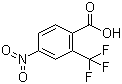 |
| Molecular Formula | C8H4F3NO4 |
| Molecular Weight | 235.12 |
| CAS Registry Number | 320-37-6 |
| EC Number | 627-696-4 |
| SMILES | C1=CC(=C(C=C1[N+](=O)[O-])C(F)(F)F)C(=O)O |
| Density | 1.6±0.1 g/cm3 Calc.* |
|---|---|
| Melting point | 138 - 132 °C (Expl.) |
| Boiling point | 321.4±42.0 °C 760 mmHg (Calc.)* |
| Flash point | 148.2±27.9 °C (Calc.)* |
| Index of refraction | 1.519 (Calc.)* |
| * | Calculated using Advanced Chemistry Development (ACD/Labs) Software. |
| Hazard Symbols |  GHS07 Warning Details GHS07 Warning Details | ||||||||||||||||||||||||
|---|---|---|---|---|---|---|---|---|---|---|---|---|---|---|---|---|---|---|---|---|---|---|---|---|---|
| Risk Statements | H302-H315-H317-H319 Details | ||||||||||||||||||||||||
| Safety Statements | P261-P264-P264+P265-P270-P272-P280-P301+P317-P302+P352-P305+P351+P338-P321-P330-P332+P317-P333+P317-P337+P317-P362+P364-P501 Details | ||||||||||||||||||||||||
| Hazard Classification | |||||||||||||||||||||||||
| |||||||||||||||||||||||||
| SDS | Available | ||||||||||||||||||||||||
 chemBlink Chemical Story
|
4-Nitro-2-(trifluoromethyl)benzoic acid is an aromatic carboxylic acid bearing two strongly electron-withdrawing substituents: a nitro group and a trifluoromethyl group, positioned on a benzoic acid core. This combination makes it a highly activated electrophilic aromatic system and a useful intermediate in synthetic organic chemistry, particularly in the preparation of more complex fluorinated and nitro-substituted compounds. The parent structure is benzoic acid, a benzene ring substituted with a carboxylic acid group. The carboxyl group is strongly electron-withdrawing through both inductive and resonance effects, making the aromatic ring less reactive toward electrophilic substitution compared with unsubstituted benzene. In this compound, this deactivation is further enhanced by the presence of additional electron-withdrawing groups. At the 4-position of the ring, a nitro group (–NO₂) is present. The nitro group is one of the most strongly electron-withdrawing substituents in aromatic chemistry due to both its powerful inductive effect and resonance withdrawal of electron density from the ring. It significantly reduces electron density at ortho and para positions and strongly deactivates the aromatic system toward electrophilic aromatic substitution. It also directs incoming electrophiles to the meta position in substitution reactions. At the 2-position, a trifluoromethyl group (–CF₃) is attached. The CF₃ group is strongly electron-withdrawing via induction due to the high electronegativity of fluorine atoms. Unlike nitro groups, it does not participate in resonance, but its inductive effect is substantial and persistent across the aromatic system. The CF₃ group also increases lipophilicity while simultaneously lowering electron density on the ring. The combined presence of nitro, trifluoromethyl, and carboxylic acid groups makes this molecule highly electron-deficient overall. As a result, the aromatic ring is strongly deactivated toward electrophilic substitution but may be more susceptible to nucleophilic aromatic substitution under appropriate conditions, especially if additional activating groups or leaving groups are introduced in derivatives. From a structural perspective, the carboxylic acid group can form hydrogen bonds and exists in equilibrium with its deprotonated carboxylate form depending on pH. This functional group also provides a reactive site for derivatization, including esterification, amidation, and formation of acid chlorides, making the compound a versatile synthetic intermediate. The nitro group is also chemically versatile. It can be reduced to an aniline group under catalytic hydrogenation or chemical reduction conditions, providing access to amino-substituted derivatives. This transformation is widely used in multi-step synthetic routes where the nitro group serves as a protected precursor to an amine functionality. The trifluoromethyl group is chemically stable under most conditions and is often introduced into molecules to modify pharmacokinetic and physicochemical properties. It increases metabolic stability, enhances membrane permeability in some contexts, and influences binding interactions in biologically active molecules due to its strong electronegativity and lipophilic character. Because of the multiple strongly polar functional groups, 4-nitro-2-(trifluoromethyl)benzoic acid is expected to be a polar aromatic compound with limited solubility in nonpolar solvents but reasonable solubility in polar organic solvents. Its carboxylic acid functionality allows for salt formation, which can significantly increase aqueous solubility under basic conditions. In synthetic chemistry, compounds of this type are often used as intermediates in the production of pharmaceuticals, agrochemicals, and functional materials. The nitro group provides a handle for further functionalization, while the CF₃ group is used to tune electronic and lipophilic properties in target molecules. Overall, 4-nitro-2-(trifluoromethyl)benzoic acid is a highly electron-deficient aromatic carboxylic acid bearing two powerful electron-withdrawing substituents. Its significance lies in its reactivity as a functionalized aromatic intermediate and its utility in constructing fluorinated and nitrogen-containing derivatives in organic synthesis. References 2019. Crystallographic and spectroscopic character-ization of 4-nitro-2-(tri-fluoro-meth-yl)benzoic acid and 4-nitro-3-(tri-fluoro-meth-yl)benzoic acid. Acta crystallographica. Section E, Crystallographic communications. DOI: 10.1107/s2056989019003979 2017. Crystal structure of a multi-domain human smoothened receptor in complex with a super stabilizing ligand. Nature Communications. DOI: 10.1038/ncomms15383 |
| Market Analysis Reports |