
Online Database of Chemicals from Around the World
| Ningbo Kilo Biotechnology Co., Ltd. | China | |||
|---|---|---|---|---|
 | www.kilobio.com | |||
 | +8613989352104 | |||
 | terry.zhang@kilobio.com | |||
 | QQ Chat | |||
 | WeChat: Wenzhou Medical University | |||
| Chemical distributor since 2023 | ||||
| chemBlink Standard supplier since 2023 | ||||
| Classification | Biochemical >> Peptide |
|---|---|
| Name | Kisspeptin-10 |
| Synonyms | Metastin (45-54); (2S)-N-[(2S)-1-[[(2S)-4-amino-1-[[(2S)-1-[[(2S)-1-[[2-[[(2S)-1-[[(2S)-1-[[(2S)-1-amino-1-oxo-3-phenylpropan-2-yl]amino]-5-(diaminomethylideneamino)-1-oxopentan-2-yl]amino]-4-methyl-1-oxopentan-2-yl]amino]-2-oxoethyl]amino]-1-oxo-3-phenylpropan-2-yl]amino]-3-hydroxy-1-oxopropan-2-yl]amino]-1,4-dioxobutan-2-yl]amino]-3-(1H-indol-3-yl)-1-oxopropan-2-yl]-2-[[(2S)-2-amino-3-(4-hydroxyphenyl)propanoyl]amino]butanediamide |
| Molecular Structure | 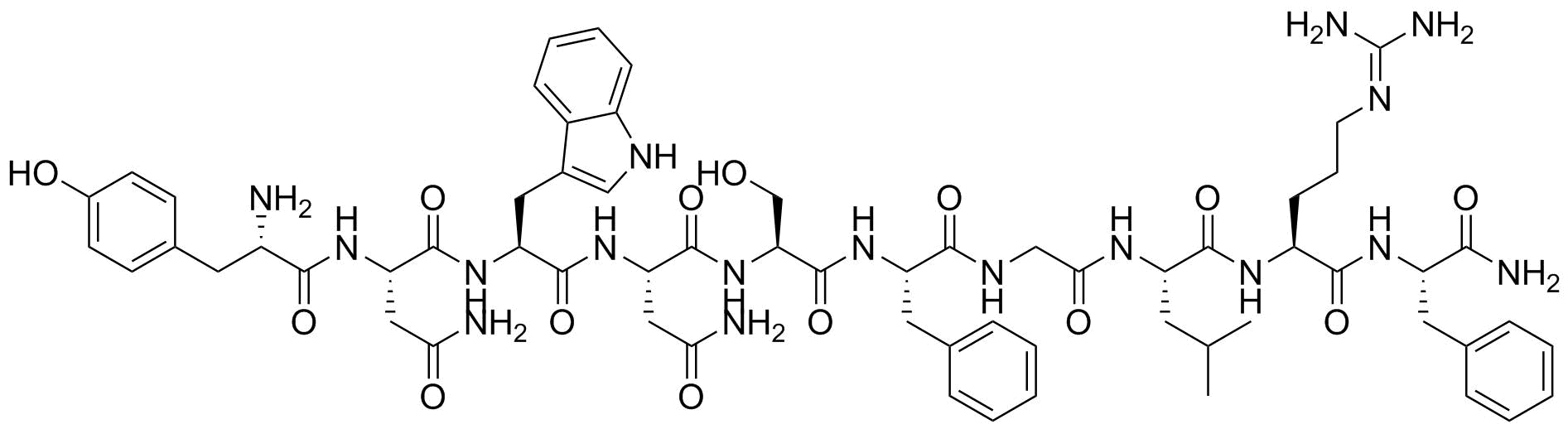 |
| Molecular Formula | C63H83N17O14 |
| Molecular Weight | 1302.44 |
| Protein Sequence | YNWNSFGLRF |
| CAS Registry Number | 374675-21-5 |
| SMILES | CC(C)C[C@@H](C(=O)N[C@@H](CCCN=C(N)N)C(=O)N[C@@H](CC1=CC=CC=C1)C(=O)N)NC(=O)CNC(=O)[C@H](CC2=CC=CC=C2)NC(=O)[C@H](CO)NC(=O)[C@H](CC(=O)N)NC(=O)[C@H](CC3=CNC4=CC=CC=C43)NC(=O)[C@H](CC(=O)N)NC(=O)[C@H](CC5=CC=C(C=C5)O)N |
| Density | |
|---|---|
| * | Calculated using Advanced Chemistry Development (ACD/Labs) Software. |
| SDS | Available |
|---|---|
 chemBlink Chemical Story
|
Kisspeptin-10 is named for its length. It is the ten-residue fragment at the carboxyl end of longer kisspeptins, retaining an amidated terminus important to the family of signaling peptides. This short fragment can activate the kisspeptin receptor, commonly called KISS1R. It shows how a relatively small part of a precursor can retain information needed for receptor recognition. The reproductive endocrine pathway helps explain why measuring a single hormone can be misleading. Kisspeptin signaling acts upstream of gonadotropin-releasing hormone. That hormone in turn drives the pituitary release of gonadotropins such as luteinizing hormone. An increase in circulating luteinizing hormone after a kisspeptin challenge is therefore a downstream observation. It is not evidence that the injected peptide is itself luteinizing hormone, or that it directly activates every tissue affected by reproductive hormones. A controlled human physiology study by Jayasena and colleagues compared reproductive hormone responses to kisspeptin-10 in men and women. Responses differed with sex and, in women, with the phase of the menstrual cycle studied. This result is interesting because it shifts attention from the peptide alone to the state of the signaling system receiving it. The same receptor ligand need not generate an identical downstream signal in every hormonal context. A peptide fragment is particularly useful when researchers want a precisely defined molecular input. Shortening a precursor can remove regions unrelated to receptor recognition while retaining the portion needed for the experiment. It can also change the fragment's persistence and distribution. Consequently, finding receptor activity in a short fragment does not mean its timing or strength will match that of every longer kisspeptin in living tissue. The distinction between an acute endocrine response and a reproductive outcome is essential. A transient change in circulating hormones can support a model of signaling without establishing a fertility treatment. Research also needs to distinguish the peptide sequence from its counterion and formulation: a salt or preparation described in one experiment cannot be assumed identical to every material marketed under the short name. The central lesson is that a ten-residue signal can be studied precisely, yet its effects still depend on a wider physiological network. References: 1. Jayasena CN et al. Effects of kisspeptin-10 on reproductive hormone release in humans. https://pubmed.ncbi.nlm.nih.gov/21976724/ 2. FDA. Pharmacy Compounding Advisory Committee briefing on kisspeptin-10 (2024). https://www.fda.gov/media/182089/download |
| Market Analysis Reports |