
Online Database of Chemicals from Around the World
| Creative Peptides | USA | |||
|---|---|---|---|---|
 | www.creative-peptides.com | |||
 | +1 (631) 624-4882 | |||
 | +1 (631) 614-7828 | |||
 | info@creative-peptides.com | |||
| Chemical manufacturer | ||||
| chemBlink Standard supplier since 2010 | ||||
| Amadis Chemical Co., Ltd. | China | |||
|---|---|---|---|---|
| www.amadischem.com | |||
| +86 (571) 8992-5085 | |||
| +86 (571) 8992-5065 | |||
| sales@amadischem.com | |||
| Chemical manufacturer since 2010 | ||||
| chemBlink Standard supplier since 2015 | ||||
| INA Pharmaceuticals Pvt. Ltd. | India | |||
|---|---|---|---|---|
| inapharma.in | |||
| +91 7815933367 | |||
| rd@inapharma.in | |||
| Chemical manufacturer since 2018 | ||||
| chemBlink Standard supplier since 2026 | ||||
| IRIS Biotech GmbH | Germany | |||
|---|---|---|---|---|
| www.iris-biotech.de | |||
| +49 (9231) 961-973 | |||
| +49 (9231) 961-999 | |||
| info@iris-biotech.de | |||
| Chemical manufacturer since 1788 | ||||
| Watanabe Chemical Ind., Ltd. | Japan | |||
|---|---|---|---|---|
| www.watanabechem.co.jp | |||
| +81 (82) 231-0540 | |||
| +81 (82) 231-1451 | |||
| inquiry@watanabechem.co.jp | |||
| Chemical manufacturer | ||||
| Classification | Biochemical >> Amino acids and their derivatives >> Glycine derivatives |
|---|---|
| Name | N-(Trifluoroacetyl)glycine |
| Synonyms | Trifluoroacetylglycine |
| Molecular Structure | 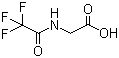 |
| Molecular Formula | C4H4F3NO3 |
| Molecular Weight | 171.07 |
| Protein Sequence | G |
| CAS Registry Number | 383-70-0 |
| EC Number | 828-193-4 |
| SMILES | C(C(=O)O)NC(=O)C(F)(F)F |
| Density | 1.5±0.1 g/cm3 Calc.* |
|---|---|
| Boiling point | 291.6±40.0 °C 760 mmHg (Calc.)*, 291.6 °C (Expl.) |
| Flash point | 130.2±27.3 °C (Calc.)*, 130 °C (Expl.) |
| Index of refraction | 1.387 (Calc.)* |
| * | Calculated using Advanced Chemistry Development (ACD/Labs) Software. |
| Hazard Symbols |  GHS07 Warning Details GHS07 Warning Details | ||||||||||||||||||||
|---|---|---|---|---|---|---|---|---|---|---|---|---|---|---|---|---|---|---|---|---|---|
| Risk Statements | H302-H315-H319-H335 Details | ||||||||||||||||||||
| Safety Statements | P261-P264-P264+P265-P270-P271-P280-P301+P317-P302+P352-P304+P340-P305+P351+P338-P319-P321-P330-P332+P317-P337+P317-P362+P364-P403+P233-P405-P501 Details | ||||||||||||||||||||
| Hazard Classification | |||||||||||||||||||||
| |||||||||||||||||||||
| SDS | Available | ||||||||||||||||||||
 chemBlink Chemical Story
|
N-(Trifluoroacetyl)glycine, CAS 383-70-0, is a fluorinated derivative of glycine used primarily as an intermediate and protected amino-acid derivative in organic synthesis. It is also known as N-(trifluoroacetyl)aminoacetic acid or TFA-Gly-OH. Its molecular formula is C4H4F3NO3 and its molecular weight is 171.07. Structurally, it is glycine in which the amino group has been acylated with a trifluoroacetyl group, CF3CO-. :contentReference[oaicite:1]{index=1} Glycine is the simplest amino acid. Its structure, H2N-CH2-COOH, contains an amino group and a carboxylic acid group on the same small carbon framework. This simplicity makes glycine chemically versatile, but it also creates a practical problem in synthesis: the amino group is reactive and may participate in reactions intended for the carboxyl group or for another part of a larger molecule. One solution is temporary N-protection. If the amino nitrogen is converted into an amide, its basicity and nucleophilicity are reduced. N-(Trifluoroacetyl)glycine is an example of this strategy. The nitrogen is no longer present as a free amine but as part of a trifluoroacetamide. The trifluoroacetyl group has unusual electronic properties because the three fluorine atoms strongly withdraw electron density. As a result, the carbonyl group is highly electron deficient and the nitrogen attached to it is less basic and less nucleophilic than the amino group of free glycine. In practical synthesis, this can make the nitrogen less likely to interfere while transformations are carried out elsewhere. This illustrates a central idea of protecting-group chemistry. A useful protecting group should change the reactivity of one functional group without permanently altering the molecular skeleton. After the required synthetic operations are complete, the protecting group can be removed under suitable conditions and the original amine regenerated. Trifluoroacetyl protection has been used for amino compounds because the group is compact and strongly electron withdrawing. Its behavior differs from bulkier carbamate protecting groups such as tert-butoxycarbonyl or fluorenylmethoxycarbonyl. The best protecting group depends on the reaction sequence, because different groups tolerate different acids, bases, oxidants, reductants, and temperatures. N-(Trifluoroacetyl)glycine also illustrates the broader chemistry of N-acyl amino acids. Formally, the molecule is produced by condensation of the amino group of glycine with trifluoroacetic acid or an activated trifluoroacetyl derivative. Chemical databases classify it as an N-acylglycine, a secondary carboxamide, and a trifluoroacetamide. :contentReference[oaicite:2]{index=2} Published synthetic descriptions include preparation from glycine and trifluoroacetylating reagents. One reported approach uses ethyl trifluoroacetate in the presence of base to introduce the trifluoroacetyl group onto glycine. This type of transformation demonstrates how a simple amino acid can be converted into a derivative with substantially different electronic properties while leaving the carboxyl group available for further chemistry. :contentReference[oaicite:3]{index=3} The carboxylic acid remains an important synthetic handle. It can be converted into esters, amides, activated derivatives, or coupled to other amino-acid or amine-containing fragments. Thus, protecting the nitrogen while leaving the carboxyl group chemically accessible allows the two functionalities of glycine to be manipulated separately. This separation of reactivity is especially important in peptide and medicinal chemistry. Amino acids contain both nucleophilic and electrophilic functional groups, so uncontrolled coupling can produce mixtures or polymeric products. Protecting one group while activating another allows chemists to build more complex structures in a defined order. N-(Trifluoroacetyl)glycine can therefore be viewed as a simple example of programmed reactivity. The glycine carbon skeleton remains almost unchanged, but attaching CF3CO- to nitrogen changes how that nitrogen behaves. A small modification can temporarily switch one functional group from "available" to "quiet." Fluorine also provides a useful analytical feature. The CF3 group contains three equivalent fluorine atoms, making trifluoroacetyl derivatives convenient subjects for fluorine-19 nuclear magnetic resonance and other analytical methods in appropriate contexts. This does not mean the compound is primarily an analytical reagent, but it illustrates one additional consequence of introducing a trifluoromethyl-containing acyl group. Commercial suppliers generally classify N-(Trifluoroacetyl)glycine as an amino-acid derivative or synthetic intermediate rather than a finished pharmaceutical product. Claims that it is tied to a specific drug should therefore be treated cautiously unless supported by a defined synthetic route. Its most secure chemical identity is as a fluorinated N-protected glycine derivative useful in further synthesis. :contentReference[oaicite:4]{index=4} The molecule is a useful reminder that protecting-group chemistry is not merely about hiding a functional group. It is about controlling time. The amine may be chemically important in the final target molecule, but during one part of the synthesis the chemist may need it to remain silent. N-(Trifluoroacetyl)glycine achieves that control with a very small structural change. Glycine supplies the simple amino-acid framework; the trifluoroacetyl group temporarily changes the personality of its nitrogen. In multistep synthesis, knowing when a functional group should react can be just as important as knowing how it reacts. References 1. NIST Chemistry WebBook. N-Trifluoroacetyl glycine, CAS 383-70-0. Molecular formula C4H4F3NO3; molecular weight 171.0747. 2. ChEBI classification for N-(trifluoroacetyl)glycine: N-acylglycine, secondary carboxamide, and trifluoroacetamide. 3. Wuts, P. G. M. Greene's Protective Groups in Organic Synthesis, 5th ed. Wiley. Protection and deprotection of amino groups. 4. Synthetic literature describing preparation of N-trifluoroacetyl amino acids from glycine and trifluoroacetylating reagents. |
| Market Analysis Reports |