
Online Database of Chemicals from Around the World
| Jinan Chenghui-Shuangda Chemical Co., Ltd. | China | |||
|---|---|---|---|---|
 | www.jnchsd.com | |||
 | +86 (531) 5889-7051 +86 15053146086 | |||
 | +86 (531) 5889-7093 | |||
 | jnchsd@qq.com | |||
 | QQ Chat | |||
| Chemical manufacturer since 2002 | ||||
| chemBlink Standard supplier since 2007 | ||||
| Simagchem Corporation | China | |||
|---|---|---|---|---|
| www.simagchem.com | |||
| +86 13806087780 | |||
| +86 (592) 268-0237 | |||
| sale@simagchem.com | |||
| Chemical manufacturer since 2002 | ||||
| chemBlink Standard supplier since 2008 | ||||
| Cangzhou Senary Chemical S & T Co., Ltd. | China | |||
|---|---|---|---|---|
| www.senary.com | |||
| +86 (317) 548-9300 | |||
| +86 (317) 548-9300 | |||
| sale01@senary.com | |||
| QQ Chat | |||
| Chemical manufacturer since 2003 | ||||
| chemBlink Standard supplier since 2008 | ||||
| BOC Sciences | USA | |||
|---|---|---|---|---|
| www.bocsci.com | |||
| +1 (631) 485-4226 | |||
| +1 (631) 614-7828 | |||
| info@bocsci.com | |||
| Chemical manufacturer | ||||
| chemBlink Standard supplier since 2010 | ||||
| Hangzhou Leap Chem Co., Ltd. | China | |||
|---|---|---|---|---|
| www.leapchem.com | |||
| +86 (571) 8771-1850 | |||
| market19@leapchem.com | |||
| QQ Chat | |||
| Chemical manufacturer since 2006 | ||||
| chemBlink Standard supplier since 2015 | ||||
| INA Pharmaceuticals Pvt. Ltd. | India | |||
|---|---|---|---|---|
| inapharma.in | |||
| +91 7815933367 | |||
| rd@inapharma.in | |||
| Chemical manufacturer since 2018 | ||||
| chemBlink Standard supplier since 2026 | ||||
| Dalton Pharma Services | Canada | |||
|---|---|---|---|---|
| www.dalton.com | |||
| +1 (416) 661-2102 | |||
| +1 (416) 661-2108 | |||
| chemist@dalton.com | |||
| Chemical manufacturer | ||||
| Chongqing Succeway Pharmaceutical Co., Ltd. | China | |||
|---|---|---|---|---|
| www.succeway.com | |||
| +86 (23) 6862-4447 | |||
| +86 (23) 6869-0600 | |||
| bgs@succeway.com | |||
| Chemical manufacturer | ||||
| Toronto Research Chemicals Inc. | Canada | |||
|---|---|---|---|---|
| www.trc-canada.com | |||
| +1 (416) 665-9696 | |||
| +1 (416) 665-4439 | |||
| info@trc-canada.com | |||
| Chemical manufacturer since 1982 | ||||
| Classification | Pharmaceutical intermediate >> Heterocyclic compound intermediate >> Pyridine compound >> Pyridine derivative |
|---|---|
| Name | 5,6-Dimethoxy-2-(pyridine-4-yl)methylene-indan-1-one |
| Synonyms | 2,3-Dihydro-5,6-dimethoxy-2-(4-pyridinylmethylene)-1H-inden-1-one |
| Molecular Structure | 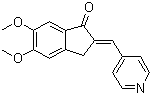 |
| Molecular Formula | C17H15NO3 |
| Molecular Weight | 281.31 |
| CAS Registry Number | 4803-74-1 |
| SMILES | COC1=C(C=C2C(=C1)C/C(=CC3=CC=NC=C3)/C2=O)OC |
| Density | 1.3±0.1 g/cm3 Calc.* |
|---|---|
| Melting point | 210-211 °C (Expl.) |
| Boiling point | 499.9±45.0 °C 760 mmHg (Calc.)* |
| Flash point | 256.1±28.7 °C (Calc.)* |
| Index of refraction | 1.639 (Calc.)* |
| * | Calculated using Advanced Chemistry Development (ACD/Labs) Software. |
| Hazard Symbols |  GHS07 Warning Details GHS07 Warning Details |
|---|---|
| Risk Statements | H302-H315-H319-H335 Details |
| Safety Statements | P261-P305+P351+P338 Details |
| SDS | Available |
 chemBlink Chemical Story
|
5,6-Dimethoxy-2-(pyridine-4-yl)methylene-indan-1-one, CAS 4803-74-1, is an organic intermediate best known for its role in the synthesis of donepezil, a cholinesterase inhibitor used in the treatment of Alzheimer's disease. Its molecular formula is C17H15NO3 and its molecular weight is 281.31. The molecule contains two recognizable structural fragments: a 5,6-dimethoxyindanone and a pyridine ring, connected through an exocyclic carbon-carbon double bond. This compound provides an unusually clear example of how the architecture of a pharmaceutical molecule can emerge step by step during synthesis. It is not donepezil itself, and it should not be assigned the pharmacological properties of donepezil. Instead, it is a key intermediate in which much of the carbon framework required for the final drug has already been assembled. The classical synthetic relationship begins with 5,6-dimethoxy-1-indanone and pyridine-4-carboxaldehyde. Under suitable condensation conditions, the carbonyl chemistry of the indanone allows formation of a new carbon-carbon bond with the aldehyde. Loss of water produces 5,6-dimethoxy-2-(4-pyridylmethylene)-1-indanone. The transformation is essentially a carbon-carbon bond-forming condensation. One starting material contributes the indanone portion, while the other contributes the pyridine ring and the carbon that connects it to the indanone framework. Instead of constructing the complete drug in one operation, the synthesis first joins two relatively simple molecular fragments. The product contains an exocyclic double bond conjugated with the indanone carbonyl group. This unsaturated linkage is particularly easy to recognize in the structure: the pyridine-containing portion has been attached to the carbon next to the ketone, but the connection has not yet been converted into the saturated linkage present in donepezil. Patents describing the manufacture of donepezil identify this compound as a key intermediate. One established route next reacts the pyridine nitrogen with benzyl bromide. The nitrogen attacks the benzyl reagent and becomes quaternized, producing a 1-benzylpyridinium intermediate. This second step is chemically important because donepezil contains an N-benzylpiperidine group. The benzyl group required in the final drug is therefore introduced while the six-membered nitrogen heterocycle is still an aromatic pyridine rather than a saturated piperidine. A subsequent reduction performs a remarkable structural conversion. Hydrogenation reduces the pyridinium-derived ring toward the piperidine structure and removes the unsaturation connecting the heterocyclic fragment to the indanone portion. The product now possesses the characteristic 5,6-dimethoxyindanone and N-benzylpiperidine architecture of donepezil. Alternative process routes change the order of some of these operations. For example, published patent descriptions include reduction of the pyridylmethylene intermediate to a piperidinylmethyl derivative followed by benzylation. What remains constant is the importance of the CAS 4803-74-1 intermediate as a convenient point at which the indanone and nitrogen-containing ring systems have already been joined. This makes the molecule particularly interesting from the perspective of retrosynthetic analysis. If the structure of donepezil is mentally taken apart, one of its most obvious divisions separates the dimethoxyindanone portion from the nitrogen-containing six-membered ring. The synthesis effectively reverses this analysis: prepare the two fragments, join them, and then adjust the oxidation state and substitution of the nitrogen-containing ring. The compound also illustrates why carbonyl condensation reactions remain so useful in pharmaceutical manufacturing. A relatively simple ketone and aldehyde can be connected through formation of a new carbon-carbon bond. The initially formed unsaturated product can then serve as a platform for several later transformations. Industrial process chemistry has devoted considerable attention to improving this particular condensation. Earlier reported routes employed reagents or conditions such as lithium diisopropylamide at very low temperature or p-toluenesulfonic acid in organic solvents. These methods could produce the required intermediate but created disadvantages in cost, safety, solvent consumption, or large-scale operation. A later patented process demonstrated that 5,6-dimethoxy-1-indanone and pyridine-4-carboxaldehyde could instead be condensed using sodium hydroxide or potassium hydroxide in demineralized water. The reaction was carried out at moderate temperature, avoiding both extremely low-temperature strong-base chemistry and large quantities of organic solvent. In one reported example, 5,6-dimethoxy-1-indanone and pyridine-4-carboxaldehyde were treated with aqueous potassium hydroxide at 25-30 °C. The isolated 5,6-dimethoxy-2-(4-pyridylmethylene)-1-indanone was reported in 98% yield and 99.71% purity. A larger example using sodium hydroxide gave 97.5% yield and 99.5% purity. These results illustrate another aspect of pharmaceutical chemistry that is often invisible in a structural formula. Discovering a route that works in a laboratory is only part of the problem. Manufacturing requires consideration of solvent volume, reagent hazards, temperature control, isolation, purification, yield, and waste generation. A compound can therefore have two different kinds of importance. To a medicinal chemist, it may be a structural stepping stone toward a biologically active molecule. To a process chemist, the same compound may become the focus of extensive work aimed at producing kilograms or more with high purity, good yield, lower cost, and safer operating conditions. CAS 4803-74-1 has also been described commercially as a donepezil-related impurity. This is not contradictory. A molecule that is deliberately produced as an intermediate during one stage of a synthesis can also become an impurity if traces remain or arise in material at a later stage. Pharmaceutical impurity control therefore requires understanding the synthetic history of the active ingredient. This dual identity is common in pharmaceutical manufacturing. "Intermediate" and "impurity" do not necessarily describe two different chemical substances; they describe the role that the same substance occupies at different points in a process. 5,6-Dimethoxy-2-(pyridine-4-yl)methylene-indan-1-one is therefore more than a complicated chemical name. Its structure captures a recognizable moment in the construction of donepezil: the indanone and pyridine fragments have already been joined, but the pyridine has not yet completed its transformation into the N-benzylpiperidine unit of the final drug. It is a molecular snapshot taken halfway through a synthesis. Looking at the intermediate and the final drug side by side reveals one of the most instructive aspects of organic chemistry: complex pharmaceutical structures are rarely created all at once. They emerge through a sequence in which each intermediate preserves what has already been built while preparing the molecule for the next transformation. References 1. US 2014/0128613 A1. "A Process for Preparation of Intermediates of Donepezil Hydrochloride." Preparation of 5,6-dimethoxy-2-(4-pyridylmethylene)-1-indanone and its use as a key donepezil intermediate. https://patents.google.com/patent/US20140128613A1/en 2. WO 2012/131540 A1. "A Process for Preparation of Intermediates of Donepezil Hydrochloride." https://patents.google.com/patent/WO2012131540A1/en 3. US 5,606,064. Process literature for preparation of donepezil and related intermediates. 4. Gotti, R.; et al. (2001). Analytical studies of donepezil and related compounds. Journal of Pharmaceutical and Biomedical Analysis, 24, 863-870. 5. Gotti, R.; et al. (2003). Analytical studies of donepezil and related substances. Analytical and Bioanalytical Chemistry, 377, 875-879. |
| Market Analysis Reports |