
Online Database of Chemicals from Around the World
| Ningbo Wingoo Semiconductor Core Material Technology Co., Ltd. | China | |||
|---|---|---|---|---|
 | www.wingooxc.com | |||
 | +86 18842662104 | |||
 | zoulin@wingooxc.com | |||
| Chemical manufacturer since 2025 | ||||
| chemBlink Standard supplier since 2026 | ||||
| Jiangsu Juming Chemical Technology Co., Ltd. | China | |||
|---|---|---|---|---|
| en.jmchemchina.com | |||
| +86 17798763151 | |||
| admin@jumingchem.com | |||
| Chemical manufacturer since 2017 | ||||
| chemBlink Standard supplier since 2026 | ||||
| Classification | Organic raw materials >> Organosilicon compound |
|---|---|
| Name | Tetrakis(N,N,N-trimethylmethanaminium) orthosilicate |
| Molecular Structure | 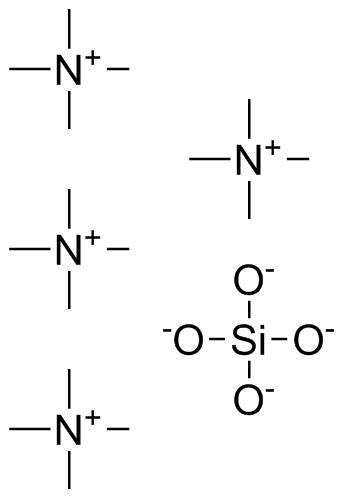 |
| Molecular Formula | C16H48N4O4Si |
| Molecular Weight | 388.66 |
| CAS Registry Number | 53116-81-7 |
| EC Number | 629-596-6 |
| SMILES | C[N+](C)(C)C.C[N+](C)(C)C.C[N+](C)(C)C.C[N+](C)(C)C.[O-][Si]([O-])([O-])[O-] |
| Hazard Symbols |  GHS05 Danger Details GHS05 Danger Details | ||||||||
|---|---|---|---|---|---|---|---|---|---|
| Risk Statements | H314 Details | ||||||||
| Safety Statements | P280-P305+P351+P338-P310 Details | ||||||||
| Hazard Classification | |||||||||
| |||||||||
| SDS | Available | ||||||||
 chemBlink Chemical Story
|
Tetrakis(N,N,N-trimethylmethanaminium) orthosilicate is a quaternary ammonium salt derived from orthosilicic acid, in which four trimethylammonium groups are associated with a central orthosilicate anion. The compound belongs to the broader class of organoammonium silicate species, which are of interest in inorganic chemistry and materials science due to their highly ionic character and their role as precursors to silica-based materials. The structure of the compound is based on the orthosilicate anion, SiO44−, which consists of a central silicon atom tetrahedrally coordinated to four oxygen atoms. Each oxygen atom carries a negative charge, which is balanced by four N,N,N-trimethylmethanaminium cations. These cations consist of a positively charged nitrogen atom bonded to three methyl groups and a methylene linkage, forming a highly substituted quaternary ammonium structure. The strong ionic interaction between the cations and the orthosilicate anion dominates the solid-state behavior of the compound. Orthosilicate species have been studied since early investigations of silicate chemistry in the 19th and early 20th centuries, when chemists began to understand the structural diversity of silicon–oxygen frameworks. The isolation of discrete orthosilicate salts with organic cations became possible with the development of quaternary ammonium chemistry in the mid-20th century. These organic cations provided improved solubility and stability compared to alkali metal silicates, enabling broader investigation of silicate reactivity in organic and mixed solvent systems. Tetrakis(N,N,N-trimethylmethanaminium) orthosilicate is typically prepared through ion-exchange or neutralization reactions involving soluble silicate precursors and quaternary ammonium hydroxides or salts. The resulting compound is often isolated as a crystalline or amorphous solid depending on the conditions of preparation. Because of its ionic nature, it exhibits good solubility in polar solvents and can participate in further chemical transformations involving the silicate core. One of the key applications of orthosilicate salts with organic cations lies in the synthesis of silica-based materials. Under hydrolysis and condensation conditions, the orthosilicate anion can undergo polymerization to form Si–O–Si networks, leading to the formation of silica gels, films, or nanoparticles. The presence of quaternary ammonium cations can influence the rate of hydrolysis and the morphology of the resulting silica structures. This has made such compounds useful in sol–gel chemistry and materials templating processes. In materials science, organoammonium orthosilicates have been investigated as precursors for porous silica materials and hybrid organic–inorganic frameworks. The organic cations can act as structure-directing agents, influencing pore size and connectivity in the resulting silica network. After thermal or chemical removal of the organic component, porous silica materials with controlled architectures can be obtained. In addition, quaternary ammonium orthosilicates have relevance in surface chemistry and catalysis research. The interaction between the silicate anion and organic cations provides a model system for studying ion pairing, solvation, and condensation reactions of silicon-oxygen species. These studies contribute to a broader understanding of silica formation in both industrial and natural environments. Overall, tetrakis(N,N,N-trimethylmethanaminium) orthosilicate is an ionic silicate compound that combines a tetrahedral orthosilicate core with organic quaternary ammonium cations. Its discovery and use are closely associated with the development of silicate chemistry and sol–gel processes. Its primary significance lies in its role as a precursor and model compound for the formation of silica-based materials and in the study of silicon–oxygen chemistry in solution and solid-state systems. |
| Market Analysis Reports |