
Online Database of Chemicals from Around the World
| wuhan chemi Pharmacy Chemical Technology Co., Ltd. | China | |||
|---|---|---|---|---|
 | www.chemipharm.com.cn | |||
 | +86 13971619949 | |||
 | gmn424@chemipharm.com.cn | |||
 | QQ Chat | |||
 | WeChat: 13971619949 | |||
| Chemical manufacturer since 2014 | ||||
| chemBlink Standard supplier since 2026 | ||||
| Classification | Pharmaceutical intermediate >> Heterocyclic compound intermediate >> Pyrimidine compound |
|---|---|
| Name | 1-(Pyrimidin-2-YL)propan-1-one |
| Molecular Structure | 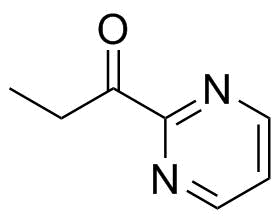 |
| Molecular Formula | C7H8N2O |
| Molecular Weight | 136.15 |
| CAS Registry Number | 54643-09-3 |
| SMILES | CCC(=O)C1=NC=CC=N1 |
| Density | 1.1±0.1 g/cm3 Calc.* |
|---|---|
| Boiling point | 263.6±23.0 °C 760 mmHg (Calc.)* |
| Flash point | 117.2±29.0 °C (Calc.)* |
| Index of refraction | 1.511 (Calc.)* |
| * | Calculated using Advanced Chemistry Development (ACD/Labs) Software. |
| Hazard Symbols |  GHS07 Warning Details GHS07 Warning Details |
|---|---|
| Risk Statements | H302-H315-H319-H335 Details |
| Safety Statements | P261-P280-P301+P312-P302+P352-P305+P351+P338 Details |
| SDS | Available |
 chemBlink Chemical Story
|
1-(Pyrimidin-2-yl)propan-1-one is a heteroaryl ketone composed of a pyrimidine ring substituted at the 2-position with a propanoyl group. It belongs to the class of pyrimidinyl aliphatic ketones, which are nitrogen-containing aromatic derivatives that combine an electron-deficient heteroaromatic system with a simple acyl side chain. Pyrimidine itself is a six-membered aromatic heterocycle containing two nitrogen atoms at the 1- and 3-positions, and it is a fundamental scaffold widely found in biologically important molecules such as nucleic acid bases and pharmaceutical agents. The development of pyrimidine chemistry has its roots in early studies of heterocyclic compounds in the late nineteenth and early twentieth centuries, when systematic exploration of nitrogen-containing aromatic systems revealed their importance in both natural products and synthetic chemistry. Pyrimidine derivatives gained particular significance due to their presence in nucleobases such as cytosine, thymine, and uracil, which established the pyrimidine framework as a core structure in biochemistry. Ketone-substituted pyrimidines such as 1-(pyrimidin-2-yl)propan-1-one are typically synthesized through acylation reactions involving pyrimidine derivatives or via transition-metal-catalyzed cross-coupling strategies. The introduction of an acyl group at the 2-position of pyrimidine can be achieved using activated carboxylic acid derivatives or through carbon–carbon bond-forming reactions involving organometallic intermediates. These methods reflect modern advances in heteroaromatic functionalization that allow precise substitution on electron-deficient aromatic systems. The presence of a carbonyl group directly attached to the pyrimidine ring introduces significant electronic interaction between the heteroaromatic system and the acyl functionality. The carbonyl group is strongly electron-withdrawing, and when conjugated with the pyrimidine ring, it further decreases electron density on the heterocycle. This can influence both the reactivity of the molecule and its behavior in coordination chemistry, where nitrogen atoms in the pyrimidine ring can act as ligands for metal centers. Pyrimidinyl ketones are of interest in organic synthesis as intermediates for further functional transformations. The carbonyl group can undergo a variety of reactions, including nucleophilic addition, reduction to secondary alcohols, or conversion into other functional groups such as imines or heterocycles through condensation reactions. These transformations make compounds like 1-(pyrimidin-2-yl)propan-1-one useful building blocks in the preparation of more complex nitrogen-containing molecules. The pyrimidine ring itself is highly relevant in medicinal chemistry due to its presence in many biologically active compounds. Substituted pyrimidines are widely used as core scaffolds in antiviral, anticancer, and antimicrobial agents. While 1-(pyrimidin-2-yl)propan-1-one is not itself a known drug substance, its structural features are consistent with intermediates used in the synthesis of bioactive pyrimidine derivatives, where substitution patterns are tuned to modify pharmacological properties. From a physicochemical perspective, the compound combines the polarity of a heteroaromatic ring containing two nitrogen atoms with the moderate polarity of a ketone group and a small aliphatic chain. This results in a molecule that is more polar than simple aromatic ketones but still retains significant organic solubility. The pyrimidine nitrogen atoms can participate in hydrogen bonding interactions as acceptors, influencing intermolecular association and solid-state packing. Spectroscopic characterization of pyrimidinyl ketones typically involves nuclear magnetic resonance spectroscopy, infrared spectroscopy, and mass spectrometry. The carbonyl group produces a characteristic infrared absorption band, while the pyrimidine protons exhibit distinct chemical shifts due to the electron-deficient nature of the ring system. These analytical techniques are routinely used to confirm structure and substitution patterns in heteroaromatic ketones. Overall, 1-(pyrimidin-2-yl)propan-1-one is a heteroaromatic ketone that reflects the broader importance of pyrimidine chemistry in organic synthesis. Its significance lies in its role as a functionalized pyrimidine building block that can undergo further chemical transformations and contributes to the extensive chemistry of nitrogen-containing aromatic systems used in synthetic and medicinal chemistry research. |
| Market Analysis Reports |