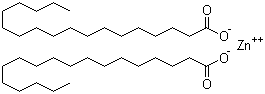
Zinc stearate belongs to the group of materials known as metal soaps. The word soap here describes a metal salt of a fatty acid, not a promise that it behaves like a water-soluble household detergent. The ideal composition corresponds to two stearate anions per zinc ion. Each stearate comes from an eighteen-carbon fatty acid with a long hydrocarbon chain and a carboxylate end that can coordinate to zinc.
A formula is useful for recording the ratio of constituents but does not require the solid to consist of separate molecules shaped exactly as a single drawing. Carboxylate groups can participate in coordination arrangements in the solid, and the long chains contribute to its wax-like character and limited affinity for water. The properties of a commercial powder can also depend on particle size and the composition of the starting fatty acids. A grade specification therefore conveys information beyond the CAS identity.
The balance between a metal-containing center and long organic chains makes zinc stearate useful in managing interfaces. In fiber-reinforced thermoset molding, technical descriptions identify it among metal soaps used for lubrication and release. When a composite part is removed from a mold, adhesion and friction at the boundary can affect how easily it separates. An additive that influences the interface can change this step even if most of the part is made from the same resin and reinforcement.
Mold release does not describe every form of lubrication. A material distributed through a molding compound and a material applied to a tool surface can affect different locations. Friction during flow and the force needed to remove a cured part are also distinct measurements. A formulation must balance the required processing behavior with the properties of the finished surface. The technical application does not imply a universal effect for every resin, tool, or grade.
One reason to evaluate a metal soap in the actual formulation is that it encounters several interfaces, not just the metal tool. A fiber-reinforced molding compound includes resin, a reinforcement, and often other additives. The compound must fill the tool and produce the intended surface after curing. An additive that is useful at one of those boundaries is not automatically useful at all of them. Formulators can compare how a part releases and how its surface accepts subsequent finishing. These are operationally different measures even when they are influenced by the same ingredient.
The term stearate also needs to be read with care. It describes the carboxylate of stearic acid and identifies the ideal fatty-acid part of the salt. It does not specify the dimensions of particles in a powder or how they are dispersed. When results from two grades differ, the difference may reflect physical form rather than a different nominal metal soap.
Zinc stearate should also be distinguished from an amide such as oleamide or ethylene bis stearamide. These additives all have long organic groups, but they attach them to different chemical centers. A metal carboxylate, a primary amide, and a diamide can interact differently with the surrounding formulation. Replacing one with another on the strength of the word lubricant would disregard the chemistry that makes the application work. Zinc stearate is interesting precisely because the fatty-acid tail and the metal carboxylate end provide different features in one material, and those features can be used to solve a practical problem at a surface.
References:
1. NOAA CAMEO Chemicals. Zinc stearate identity and physical description. https://cameochemicals.noaa.gov/report?key=CH25084
2. Baerlocher. Metal soaps in SMC/BMC applications. https://www.baerlocher.com/applications/plastics/smc-bmc/
|







 GHS07;GHS09 Warning Details
 chemBlink Chemical Story