
Online Database of Chemicals from Around the World
| Chengdu Pukang Biotechnology Co., Ltd. | China | |||
|---|---|---|---|---|
 | www.pu-kang.com | |||
 | +86 (28) 8255-0498 | |||
 | +86 (28) 8255-0468 | |||
 | sales@pu-kang.com | |||
 | QQ Chat | |||
| Chemical manufacturer since 2008 | ||||
| chemBlink Standard supplier since 2008 | ||||
| Furucon Biotechnology Co., Ltd. | China | |||
|---|---|---|---|---|
| www.pegchemical.com | |||
| +86 (28) 8255-0498 | |||
| +86 (28) 8255-0468 | |||
| sales@pegchemical.com | |||
| Chemical distributor since 2013 | ||||
| chemBlink Standard supplier since 2015 | ||||
| Chengdu Aslee Biopharmaceuticals, Inc. | China | |||
|---|---|---|---|---|
| www.asleechem.com | |||
| +86 (28) 8530-5008 +86 15102825326 | |||
| may.yang@asleechem.com | |||
| QQ Chat | |||
 | Skype Chat | |||
| Chemical manufacturer since 2013 | ||||
| chemBlink Standard supplier since 2020 | ||||
| Changzhou Jiuwu Chemical Co., Ltd. | China | |||
|---|---|---|---|---|
| www.jiuwuchem.com | |||
| +86 (519) 8512-1086 +86 13775162768 | |||
| +86 (519) 8512-5369 | |||
| info@jiuwuchem.cn | |||
| QQ Chat | |||
| Chemical manufacturer since 2009 | ||||
| chemBlink Standard supplier since 2023 | ||||
| Classification | Organic raw materials >> Carboxylic compounds and derivatives >> Carboxylic esters and their derivatives |
|---|---|
| Name | 10-Oxo-5,8,14,17-tetraoxa-2,11-diazanonadecanedioic acid 1-(9H-fluoren-9-ylmethyl) ester |
| Synonyms | Fmoc-AEEA-AEEA |
| Molecular Structure | 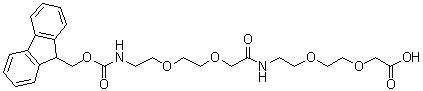 |
| Molecular Formula | C27H34N2O9 |
| Molecular Weight | 530.57 |
| CAS Registry Number | 560088-89-3 |
| SMILES | C1=CC=C2C(=C1)C(C3=CC=CC=C32)COC(=O)NCCOCCOCC(=O)NCCOCCOCC(=O)O |
| Solubility | Very slightly soluble (0.48 g/L) (25 °C), Calc.* |
|---|---|
| Density | 1.256±0.06 g/cm3 (20 °C 760 Torr), Calc.* |
| Boiling point | 757.6±70.0 °C 760 mmHg (Calc.)* |
| Flash point | 412.0±35.7 °C (Calc.)* |
| Index of refraction | 1.573 (Calc.)* |
| * | Calculated using Advanced Chemistry Development (ACD/Labs) Software. |
| Hazard Symbols |  GHS07 Warning Details |
|---|---|
| Risk Statements | H302-H315-H319-H335 Details |
| Safety Statements | P280-P305+P351+P338 Details |
| SDS | Available |
 chemBlink Chemical Story
|
In a modified peptide, the short connection between two functional parts can matter as much as either part alone. Fmoc-AEEA-AEEA, CAS 560088-89-3, is a defined spacer building block that makes this connection chemically accessible. Its long systematic name describes a molecule containing ether-rich segments, an internal amide, a protected amino end, and a free carboxylic acid end. AEEA denotes 8-amino-3,6-dioxaoctanoic acid. Joining two such units through an amide creates a discrete two-unit structure, rather than a sample of polyethylene glycol with a distribution of chain lengths. The molecule contains four ether oxygen atoms in its spacer segments. Fmoc protects one terminal amino function, and the opposite carboxyl group remains available for coupling. The extra amino and carboxyl functions used to join the two units have become the internal amide. This defined identity matters when the spacer is introduced into a larger product. A mixture of oligomer lengths can give multiple related conjugates, whereas a discrete building block specifies one intended connectivity and atom count. That advantage concerns molecular definition; it does not imply that every supplied batch is pure or that all possible side products are absent. Those questions still require the appropriate analytical evidence. The ether-rich structure can contribute polarity and flexibility between attached groups. However, a flexible spacer does not maintain one fixed distance between its endpoints like a rigid rod. It samples conformations, and its influence depends on what is attached at each end. Increasing nominal length can therefore change more than separation alone, including the ensemble of accessible shapes and interactions with the surrounding medium. A prominent context for the AEEA-AEEA segment is the side-chain architecture of semaglutide. The original 2015 discovery report by Lau and colleagues examined a modified GLP-1 analogue with an engineered acyl side chain and linker. That provides a documented example of the structural segment in a completed peptide. It does not make the isolated Fmoc-protected spacer a GLP-1 receptor agonist or establish the final peptide's properties for the building block itself. Assembly explains the distinction. The free acid can be used to connect the spacer to an appropriate amine, and removal of terminal Fmoc can expose the other amino function for a subsequent bond. The order and partners depend on the chosen synthesis. The final conjugate no longer has the same chemical identity as the protected precursor, because its functional groups have been transformed and connected to additional molecular components. It is also important to separate a linker contribution from the behavior of an entire modified peptide. Receptor interaction, protein association, enzymatic processing, and persistence can depend on multiple structural features together. Observing a useful final molecule cannot establish that the spacer alone produces each outcome, nor that the same spacer improves every unrelated peptide. Controlled comparisons are needed to assign particular effects. The internal amide also distinguishes this spacer from an uninterrupted chain of ether repeats. Its carbonyl and N-H introduce a different bonding environment within the connector, so calling the whole molecule PEG without qualification omits a chemically meaningful part of the structure. Fmoc-AEEA-AEEA is therefore best understood as a precisely defined part of molecular architecture. Its value lies in making a flexible, ether-containing connection reproducible during synthesis. The compound offers an instructive example of why a linker is an active design choice in chemical construction, even though it is neither the peptide sequence nor the final conjugate's complete functional system. References: 1. AAPPTec. Fmoc-AEEA-AEEA, product LSP353; CAS 560088-89-3. https://www.peptide.com/product/fmoc-aeea-aeea-560088-89-3/ 2. PubChem. Fmoc-AEEA-AEEA, CID 51340574: defined structure. https://pubchem.ncbi.nlm.nih.gov/compound/51340574 3. Lau J et al. Discovery of the Once-Weekly Glucagon-Like Peptide-1 (GLP-1) Analogue Semaglutide. Journal of Medicinal Chemistry (2015). https://doi.org/10.1021/acs.jmedchem.5b00726 |
| Market Analysis Reports |