
Online Database of Chemicals from Around the World
| Shanghai RC Chemicals Co., Ltd. | China | |||
|---|---|---|---|---|
 | www.rcc.net.cn | |||
 | +86 (21) 5032-2175 5866-1250 ex 603 | |||
 | +86 (21) 5032-2176 / 5866-1251 | |||
 | sales@rcc.net.cn chad@rcc.net.cn | |||
| Chemical manufacturer since 2006 | ||||
| chemBlink Standard supplier since 2007 | ||||
| Simagchem Corporation | China | |||
|---|---|---|---|---|
| www.simagchem.com | |||
| +86 13806087780 | |||
| +86 (592) 268-0237 | |||
| sale@simagchem.com | |||
| Chemical manufacturer since 2002 | ||||
| chemBlink Standard supplier since 2008 | ||||
| ZONK Drug R&D Limited | China | |||
|---|---|---|---|---|
| www.zonk.cn | |||
| +86 (20) 3205-1076 +86 13922751178 | |||
| +86 (20) 3205-1083 | |||
| nzwangwei@hotmail.com | |||
| Chemical manufacturer since 2005 | ||||
| chemBlink Standard supplier since 2008 | ||||
| Changzhou Hi-Tech Chemistry Corp | China | |||
|---|---|---|---|---|
| www.eastfine.net | |||
| +86 (519) 8662-7600 | |||
| +86 (519) 8662-9716 | |||
| sales@watsonchem.com | |||
| Chemical manufacturer | ||||
| chemBlink Standard supplier since 2009 | ||||
| Shanghai Yurlic Chemical S&T Co., Ltd. | China | |||
|---|---|---|---|---|
| www.yurlichem.com | |||
| +86 (21) 37285141 +86 15000957566 | |||
| +86 (21) 37285142 / 5736-5707 | |||
| yurlichem@hotmail.com sales@yurlichem.cn | |||
 | QQ Chat | |||
| Chemical manufacturer since 2004 | ||||
| chemBlink Standard supplier since 2009 | ||||
| BOC Sciences | USA | |||
|---|---|---|---|---|
| www.bocsci.com | |||
| +1 (631) 485-4226 | |||
| +1 (631) 614-7828 | |||
| info@bocsci.com | |||
| Chemical manufacturer | ||||
| chemBlink Standard supplier since 2010 | ||||
| Beijing Infoark Technology Development Co., Ltd. | China | |||
|---|---|---|---|---|
| www.infoark.com.cn | |||
| +86 (10) 5166-8333 ex 221, 240, 211 | |||
| +86 (10) 8815-2455 ex 221, 240, 211 | |||
| intermediate@infoark.com.cn yanlixie_cn@hotmail.com | |||
| Chemical manufacturer | ||||
| chemBlink Standard supplier since 2011 | ||||
| Intatrade Chemicals GmbH | Germany | |||
|---|---|---|---|---|
| www.intatrade.de | |||
| +49 (3493) 605-465 | |||
| +49 (3493) 605-470 | |||
| sales@intatrade.de | |||
| Chemical distributor | ||||
| chemBlink Standard supplier since 2011 | ||||
| Changzhou Dongchen Pharmtech Co., Ltd. | China | |||
|---|---|---|---|---|
| www.dcpharmtech.com | |||
| +86 (519) 8899-5800 | |||
| +86 (519) 8899-5808 | |||
| gjf@dcpharmtech.com jeffrey_gjf@hotmail.com | |||
| QQ Chat | |||
| Chemical manufacturer since 2012 | ||||
| chemBlink Standard supplier since 2013 | ||||
| Hangzhou Leap Chem Co., Ltd. | China | |||
|---|---|---|---|---|
| www.leapchem.com | |||
| +86 (571) 8771-1850 | |||
| market19@leapchem.com | |||
| QQ Chat | |||
| Chemical manufacturer since 2006 | ||||
| chemBlink Standard supplier since 2015 | ||||
| Wuxi Jingyao Biomedical Co., Ltd. | China | |||
|---|---|---|---|---|
| www.jingyaobiotech.cn | |||
| +86 (510) 8877-0633 | |||
| +86 (510) 8877-0633 | |||
| jingyaobiotech@126.com | |||
| Chemical distributor since 2015 | ||||
| chemBlink Standard supplier since 2016 | ||||
| Klong Industrial Co., Ltd. | China | |||
|---|---|---|---|---|
| www.klongchem.com | |||
| +86 (519) 6823-1162 | |||
| info@klongchem.com | |||
| Chemical distributor since 2017 | ||||
| chemBlink Standard supplier since 2017 | ||||
| Shanghai Fuxin Pharmaceutical Co., Ltd. | China | |||
|---|---|---|---|---|
| www.fuxinpharm.com | |||
| +86 (21) 3130-0828 +86 18645121291 | |||
| +86 (21) 3130-0828 | |||
| contact@fuxinpharm.com | |||
| Chemical manufacturer since 2016 | ||||
| chemBlink Standard supplier since 2018 | ||||
| Neostar United (Changzhou) Industrial Co., Ltd. | China | |||
|---|---|---|---|---|
| www.neostarunited.com | |||
| +86 (519) 8555-7386 +86 18015025600 | |||
| +86 (519) 8555-7389 | |||
| marketing1@neostarunited.com | |||
| Chemical distributor since 2014 | ||||
| chemBlink Standard supplier since 2020 | ||||
| INA Pharmaceuticals Pvt. Ltd. | India | |||
|---|---|---|---|---|
| inapharma.in | |||
| +91 7815933367 | |||
| rd@inapharma.in | |||
| Chemical manufacturer since 2018 | ||||
| chemBlink Standard supplier since 2026 | ||||
| Anvia Chemicals, LLC | USA | |||
|---|---|---|---|---|
| www.anviachem.com | |||
| +1 (414) 534-7845 | |||
| +1 (414) 762-5539 | |||
| sales@anviachem.com | |||
| Chemical manufacturer | ||||
| Classification | Biochemical >> Amino acids and their derivatives >> Glycine derivatives |
|---|---|
| Name | Ethyl N-(diphenylmethylene)glycinate |
| Synonyms | N-(Diphenylmethylene)glycine ethyl ester |
| Molecular Structure | 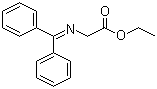 |
| Molecular Formula | C17H17NO2 |
| Molecular Weight | 267.32 |
| CAS Registry Number | 69555-14-2 |
| EC Number | 614-987-6 |
| SMILES | CCOC(=O)CN=C(C1=CC=CC=C1)C2=CC=CC=C2 |
| Density | 1.0±0.1 g/cm3 Calc.* |
|---|---|
| Melting point | 51 - 53 °C (Expl.) |
| Boiling point | 357.9±34.0 °C 760 mmHg (Calc.)* |
| Flash point | 138.0±20.1 °C (Calc.)*, 110 °C (Expl.) |
| Index of refraction | 1.542 (Calc.)* |
| * | Calculated using Advanced Chemistry Development (ACD/Labs) Software. |
| Hazard Symbols |  GHS07 Warning Details GHS07 Warning Details | ||||||||||||||||||||
|---|---|---|---|---|---|---|---|---|---|---|---|---|---|---|---|---|---|---|---|---|---|
| Risk Statements | H315-H319-H335 Details | ||||||||||||||||||||
| Safety Statements | P261-P305+P351+P338 Details | ||||||||||||||||||||
| Hazard Classification | |||||||||||||||||||||
| |||||||||||||||||||||
| SDS | Available | ||||||||||||||||||||
 chemBlink Chemical Story
|
Ethyl N-(diphenylmethylene)glycinate, CAS 69555-14-2, is a protected glycine derivative widely used as a building block for the synthesis of α-amino acids. It is also known as N-(diphenylmethylene)glycine ethyl ester and is often referred to as O'Donnell's reagent. Its molecular formula is C17H17NO2 and its molecular weight is 267.32. Its structure can be represented as (C6H5)2C=NCH2CO2C2H5. The molecule looks considerably more complicated than glycine, but much of that complexity is temporary. Glycine itself is NH2CH2CO2H, the simplest α-amino acid. In Ethyl N-(diphenylmethylene)glycinate, the carboxylic acid has been converted into an ethyl ester, while the amino group is incorporated into an imine formed with benzophenone. These modifications transform glycine into a much more convenient synthetic reagent. The central CH2 group is the key. It lies between the imine nitrogen and ester carbonyl. Under basic conditions, a proton can be removed from this carbon, generating a nucleophilic carbon species that can react with an electrophile. Chemists can therefore use the molecule as an "anionic glycine equivalent": the protected glycine framework is temporarily converted into a carbon nucleophile. This provides a remarkably direct way to make new amino acids. Suppose the electrophile is benzyl bromide, C6H5CH2Br. Alkylation introduces a benzyl group at the α-carbon of the protected glycine derivative. The carbon skeleton has now changed from the skeleton of glycine toward that of phenylalanine. After the temporary imine protection is removed and the ester is hydrolyzed as required, the amino-acid functionality can be revealed again. This is the central synthetic idea: protect glycine, modify its carbon skeleton, then uncover the amino acid. Published studies have demonstrated that Ethyl N-(diphenylmethylene)glycinate can undergo monoalkylation, dialkylation, and Michael addition under phase-transfer catalytic conditions. Further transformations of the resulting products have provided α-alkylated aspartic and glutamic acid derivatives, bicyclic amino acids, and other structurally modified amino-acid derivatives. Phase-transfer catalysis is particularly important in this chemistry. The reaction often involves an aqueous solution of a strong base and an organic phase containing the glycine derivative and alkylating reagent. These components would normally have difficulty reacting efficiently because they prefer different phases. A phase-transfer catalyst helps reactive ionic species move between these environments, allowing the deprotonation and carbon-carbon bond-forming chemistry to proceed effectively. This seemingly practical solution became the basis for something even more important: asymmetric amino-acid synthesis. When ordinary achiral conditions are used, alkylation creates a new stereogenic center at the α-carbon whenever two different carbon substituents are attached. The two mirror-image products can therefore be formed. But biological molecules care deeply about this distinction. Proteins are constructed almost entirely from one stereochemical family of amino acids, and medicinal chemistry often requires one enantiomer rather than a mixture. Researchers consequently developed chiral phase-transfer catalysts capable of controlling which face of the glycine-derived intermediate reacts with an alkylating agent. Ethyl N-(diphenylmethylene)glycinate became one of the standard substrates for studying this approach. Cinchona-alkaloid-derived catalysts and many later catalyst designs have been evaluated by asking how selectively they can convert this protected glycine derivative into one enantiomer of an α-substituted amino-acid precursor. This is a remarkable transformation of roles. The benzophenone-derived imine initially looks like a large permanent part of the molecule. In reality, its two phenyl rings are temporary synthetic equipment. They help control the nitrogen functionality and influence the chemistry of the adjacent carbon, but they do not need to remain in the final amino acid. The ethyl ester plays a similar supporting role. It changes the properties of the carboxyl group during synthesis and can later be hydrolyzed. What remains after these temporary features are removed is the chemically important result: a modified amino-acid carbon skeleton. This strategy can be compared to molecular scaffolding. Scaffolding around a building may be larger and more conspicuous than some parts of the finished structure, but its purpose is to make construction possible. Once the work is complete, the scaffolding disappears. The diphenylmethylene group performs a similar function here. The reagent is also a good illustration of why glycine occupies a special place in amino-acid synthesis. Glycine has no carbon side chain; its α-carbon carries two hydrogens. Replacing one of those hydrogens with a new carbon group effectively creates a substituted amino acid. Change the alkylating reagent, and the newly introduced side chain changes. This modularity allows one common glycine-derived starting material to serve as the entry point to many different amino-acid structures. The reaction can become even more sophisticated when the α-carbon is modified more than once or when the nucleophilic glycine equivalent undergoes conjugate addition to an unsaturated acceptor. Published work has used these possibilities to construct α-disubstituted amino acids and more elaborate cyclic structures. Ethyl N-(diphenylmethylene)glycinate therefore represents an important philosophy of synthetic chemistry. A chemist does not always modify the molecule that is ultimately wanted directly. Sometimes the desired molecule is first disguised. Functional groups are protected. Acidity is adjusted. Reactivity is redirected. Temporary structural elements are added so that one particular carbon atom can perform chemistry it could not perform conveniently in the original molecule. Then, after the new carbon-carbon bond has been made, those temporary structures are removed. What appears at first to be a bulky 17-carbon molecule is therefore best understood as a carefully engineered version of something much simpler: glycine prepared for carbon-carbon bond formation. Its two phenyl rings are temporary. Its new side chain is not. That difference is what makes Ethyl N-(diphenylmethylene)glycinate such a useful tool for building amino acids. References 1. Sigma-Aldrich. N-(Diphenylmethylene)glycine ethyl ester, CAS 69555-14-2. Molecular formula C17H17NO2; molecular weight 267.32. 2. López, A.; Moreno-Mañas, M.; Pleixats, R.; Roglans, A.; Ezquerra, J.; Pedregal, C. (1996). "Ethyl N-(diphenylmethylene)glycinate as anionic glycine equivalent. Monoalkylation, dialkylation and Michael additions under solid-liquid phase-transfer catalysis." Tetrahedron, 52. 3. O'Donnell, M. J. et al. Studies of phase-transfer-catalyzed alkylation of protected glycine derivatives for amino-acid synthesis. 4. Chenault, H. K. et al. (1989). Journal of the American Chemical Society, 111, 6354-6364. Preparation of amino-acid derivatives using phase-transfer-catalyzed alkylation of Ethyl N-(diphenylmethylene)glycinate. 5. Studies of enantioselective phase-transfer alkylation of N-(diphenylmethylene)glycine ethyl ester using chiral catalysts. |
| Market Analysis Reports |