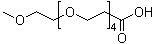
4,7,10,13,16-Pentaoxaheptadecanoic acid combines a methyl-capped ether chain with a propionic acid terminus. Five oxygens occupy positions along the named chain, while the carboxyl group contributes two more. The formula is C₁₂H₂₄O₇. Names such as m-PEG5-acid and mPEG4-CH₂CH₂COOH occur for this structure, illustrating why a PEG numeral alone is a less reliable identifier than the complete connectivity and CAS association.
The acid end contains the sequence –O–CH₂CH₂COOH. The two methylene groups between the last ether oxygen and the carboxyl carbon distinguish it from a corresponding oxyacetic acid derivative. At the opposite end, a methyl ether supplies a cap rather than a second free alcohol. Thus, the readily available terminal acid has a role that the methyl-capped end does not share.
A concrete application appears in patent CN120617538A, published in 2025. A synthetic step explicitly identifies this CAS number and uses the acid in constructing a larger intermediate for antibody–drug conjugate research. The acid is introduced through coupling chemistry, and the resulting compound is isolated and characterized. This documents participation of the building block in a particular route, rather than proving an anticancer effect for the free acid itself.
The distinction between attachment and bridging is useful. Coupling the acid to an amine can place an ether-rich tail on another molecule, but it does not automatically provide a second reactive terminal group for joining yet another partner. The methyl cap remains part of the new product. A completed conjugate's architecture must be read from all its components, not inferred from the general label linker.
The chain is compositionally defined but conformationally flexible. Its ether oxygens provide polar interaction sites, and its bonds allow many arrangements. Neither the formula nor a stretched drawing establishes a unique spacing or guarantees improved performance after attachment. The supported significance is a specified acid-functional building block with a documented coupling example. Properties such as the solubility or biological behavior of the completed derivative remain properties to establish for that derivative.
References:
1. PubChem. m-PEG5-acid, CID 21897078, CAS 81836-43-3. https://pubchem.ncbi.nlm.nih.gov/compound/21897078
2. Precise PEG. m-PEG5-Acid, structural specification. https://precisepeg.com/products/m-peg5-acid
3. CN120617538A. Antibody-drug conjugate for treating tumors, compound 1-4 preparation. https://patents.google.com/patent/CN120617538A/en
|






 GHS07 Warning Details
 chemBlink Chemical Story