
Online Database of Chemicals from Around the World
| Jiangsu Juming Chemical Technology Co., Ltd. | China | |||
|---|---|---|---|---|
 | en.jmchemchina.com | |||
 | +86 17798763151 | |||
 | admin@jumingchem.com | |||
| Chemical manufacturer since 2017 | ||||
| chemBlink Standard supplier since 2026 | ||||
| Classification | Organic raw materials >> Carboxylic compounds and derivatives >> Carboxylic esters and their derivatives |
|---|---|
| Name | 1-Butoxyethyl methacrylate |
| Molecular Structure | 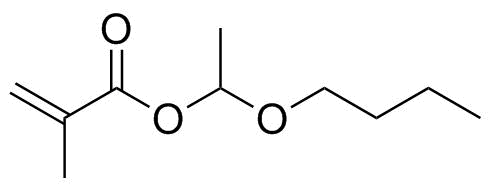 |
| Molecular Formula | C10H18O3 |
| Molecular Weight | 186.25 |
| CAS Registry Number | 85997-75-7 |
| SMILES | CCCCOC(C)OC(=O)C(=C)C |
 chemBlink Chemical Story
|
1-Butoxyethyl methacrylate, CAS 85997-75-7, is a specialty methacrylate monomer. Its chemical story is best understood by looking at how its structure creates function rather than by treating the name as a simple catalog label. The molecule or material combines a polymerizable methacrylate double bond and an ether-containing butyl side group, a combination that explains its relevance to modular polymer building-block chemistry. Under radical initiation the methacrylate double bond can become part of a polymer backbone. The butyl portion adds hydrocarbon character and flexibility, while the ether oxygen adds polarity. Changing this side group can influence monomer compatibility, glass-transition behavior and polymer flexibility without changing the basic methacrylate polymerization mechanism. Open literature for this exact monomer is sparse. It should therefore be described as a polymerizable building block rather than assigned a specific undocumented coating, adhesive or resist application. A broader lesson follows from this example. Chemical identity is only the starting point for performance. In polymers and surfactants, composition, molecular distribution and formulation can dominate behavior; in synthetic intermediates, the value may lie in transformations that occur only in later steps; in biologically active compounds, mechanism must be separated from clinical evidence. For 1-Butoxyethyl methacrylate, the most reliable interpretation is therefore the one supported by its documented chemistry and literature rather than an assumed application. The compound also illustrates why specialty chemicals often look more complicated than their job description suggests. Functional groups are selected to solve different parts of a practical problem: one region may provide reactivity, another solubility or interfacial affinity, and another stability or a controllable breaking point. Once those roles are separated, the long chemical name becomes a map of molecular design. References: Sigma-Aldrich / AA Blocks, 1-Butoxyethyl methacrylate, CAS 85997-75-7; Odian G. Principles of Polymerization. 4th ed. Wiley, 2004; Young RJ, Lovell PA. Introduction to Polymers. 3rd ed. CRC Press, 2011. |
| Market Analysis Reports |