
Online Database of Chemicals from Around the World
| BOC Sciences | USA | |||
|---|---|---|---|---|
 | www.bocsci.com | |||
 | +1 (631) 485-4226 | |||
 | +1 (631) 614-7828 | |||
 | info@bocsci.com | |||
| Chemical manufacturer | ||||
| chemBlink Standard supplier since 2010 | ||||
| Suzhou Fosai New Material Co., Ltd. | China | |||
|---|---|---|---|---|
| www.fosai.com | |||
| +86 18662206522 | |||
| +86 (512) 6238-6211 | |||
| sale_fosai@163.com zhou.xiaojin@fosai.com | |||
| Chemical manufacturer | ||||
| chemBlink Standard supplier since 2011 | ||||
| Sichuan Hersbit Scientific and Technical Co., Ltd. | China | |||
|---|---|---|---|---|
| www.hpccellulose.com | |||
| +86 18010683253 | |||
| 18982708894@163.com | |||
 | QQ Chat | |||
 | WeChat: 18010683253 | |||
 | WhatsApp:+86 190 4119 6033 | |||
| Chemical distributor since 2018 | ||||
| chemBlink Standard supplier since 2026 | ||||
| Classification | Biochemical >> Carbohydrate |
|---|---|
| Name | Ammonium carboxymethyl cellulose |
| Synonyms | Cellulose carboxymethyl ether ammonium salt |
| Molecular Structure | 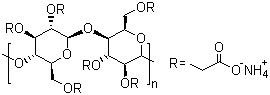 |
| CAS Registry Number | 9086-60-6 |
| EC Number | 618-670-3 |
 chemBlink Chemical Story
|
Ammonium carboxymethyl cellulose is better understood as a chemically modified polymer material than as a small molecule with one fixed molecular weight. Cellulose supplies the long carbohydrate backbone. Some hydroxyl groups are converted to carboxymethyl ethers, and ammonium ions balance negatively charged carboxylate groups. The US Environmental Protection Agency's substance registry associates CAS 9086-60-6 with this ammonium salt, not with sodium carboxymethyl cellulose or an unmodified cellulose fiber. The distinction between backbone, substitution and counterion is important. Carboxymethylation introduces –O–CH₂COO⁻ groups through ether connections; it does not simply attach ammonium ions to otherwise unchanged cellulose. The ammonium is a counterion rather than a covalent amino group grafted onto every sugar unit. Changing the counterion changes the salt form, while changing the degree of substitution changes how many cellulose hydroxyls have been modified on average. As a result, a CAS identity does not determine every processing property. Chain-length distribution, substitution level, moisture and the method used to prepare a solution can all matter. A viscosity value should therefore be tied to a concentration, temperature and measurement context. It cannot be treated like the molecular weight of a pure, discrete organic reagent or assigned to every grade of the material. An instructive application appears in a 2024 patent disclosure concerning cordierite honeycomb ceramics. The proposed process uses a low-viscosity ammonium carboxymethyl cellulose grade as a binder in a water-containing mixture of inorganic powders. The binder's task is to help make and handle the shaped body before the final ceramic is obtained. The disclosure specifies a solution-based viscosity range, underscoring that the chosen processing grade is more specific than the general substance name. This role creates an interesting contrast between temporary and permanent construction. The cellulose-derived material helps organize the wet mixture and the unfired shape, while the inorganic components become the ceramic during firing. The organic binder is not supposed to remain as an intact cellulose chain inside the final high-temperature ceramic. Its usefulness is connected to an earlier stage of manufacture, rather than to being a permanent reinforcing fiber in the finished article. A separate mullite-ceramic patent identifies another reason to consider the ammonium form: avoiding the deliberate introduction of alkali-metal or alkaline-earth-metal counterions through the binder. That is a compositional distinction from selecting a sodium salt. It does not prove that every supplied ammonium grade is free of all metal impurities, or that counterion choice alone determines a ceramic's performance. The complete formulation and thermal treatment remain essential. The degree of substitution is commonly expressed as the average number of modified hydroxyl groups per anhydroglucose unit. It is an average over the polymer material, not a statement that every repeat unit has the same substituents at the same positions. This helps explain why a simple repeating-unit drawing cannot fully specify the composition and solution behavior of an actual binder grade. These examples give the polymer a specific materials story without borrowing every use of the much more familiar sodium carboxymethyl cellulose. A food, pharmaceutical or biomedical application of another salt cannot automatically be assigned to this one. Here, the directly documented angle is control of processing through a cellulose-derived, ammonium-form binder. The chemistry of the substituent and counterion helps explain why a seemingly modest change in a polymer's name can matter during the making of a very different material. References: 1. US EPA Substance Registry Services. Cellulose, carboxymethyl ether, ammonium salt, CAS 9086-60-6. https://cdxapps.epa.gov/oms-substance-registry-services/substance-details/166074 2. CN119219403A. A cordierite honeycomb ceramic material with low heat capacity and high specific surface area and preparation method thereof. https://patents.google.com/patent/CN119219403A/en 3. CN118993710B. Acicular mullite porous ceramic material and preparation method thereof. https://patents.google.com/patent/CN118993710B/en |
| Market Analysis Reports |