
Online Database of Chemicals from Around the World
| Hangzhou Leap Chem Co., Ltd. | China | |||
|---|---|---|---|---|
 | www.leapchem.com | |||
 | +86 (571) 8771-1850 | |||
 | market19@leapchem.com | |||
 | QQ Chat | |||
| Chemical manufacturer since 2006 | ||||
| chemBlink Standard supplier since 2015 | ||||
| Wonderchem Co., Limited | Hong Kong | |||
|---|---|---|---|---|
| www.wonder-chem.com | |||
| +852 8192-5218 | |||
| sales@wonder-chem.com | |||
| Chemical distributor since 2016 | ||||
| chemBlink Standard supplier since 2017 | ||||
| V-Ran Biotechnology Co., Ltd. | China | |||
|---|---|---|---|---|
| www.v-ran.com | |||
| +86 (0531) 8851-6570 | |||
| jt@weiran-sw.com | |||
 | WeChat: 86-17753131700 | |||
| Chemical manufacturer since 2014 | ||||
| chemBlink Standard supplier since 2026 | ||||
| Classification | Organic raw materials >> Alcohols, phenols, phenolic compounds and derivatives |
|---|---|
| Name | 5-Chloro-2-pyrimidinemethanol |
| Molecular Structure | 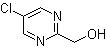 |
| Molecular Formula | C5H5ClN2O |
| Molecular Weight | 144.56 |
| CAS Registry Number | 944902-98-1 |
| EC Number | 999-495-2 |
| SMILES | C1=C(C=NC(=N1)CO)Cl |
| Solubility | Soluble (90 g/L) (25 °C), Calc.* |
|---|---|
| Density | 1.422±0.06 g/cm3 (20 °C 760 Torr), Calc.* |
| Boiling point | 238.4±20.0 °C 760 mmHg (Calc.)* |
| Flash point | 98.0±21.8 °C (Calc.)* |
| Index of refraction | 1.579 (Calc.)* |
| * | Calculated using Advanced Chemistry Development (ACD/Labs) Software. |
| Hazard Symbols |  GHS07 Warning Details GHS07 Warning Details |
|---|---|
| Risk Statements | H302-H315-H319-H335 Details |
| Safety Statements | P261-P264-P264+P265-P270-P271-P280-P301+P317-P302+P352-P304+P340-P305+P351+P338-P319-P321-P330-P332+P317-P337+P317-P362+P364-P403+P233-P405-P501 Details |
| SDS | Available |
 chemBlink Chemical Story
|
5-Chloro-2-pyrimidinemethanol is a small heteroaromatic building block containing an electron-poor pyrimidine ring, chlorine, and a hydroxymethyl group. The two functional handles have complementary synthetic roles. The primary alcohol can be oxidized, esterified, converted into a leaving group, or incorporated into ether and other linkages, while chlorine on the pyrimidine ring can undergo nucleophilic aromatic substitution and, under suitable conditions, coupling chemistry. Pyrimidines are common motifs in pharmaceuticals and biological molecules, but that broad importance is not evidence of a specific biological action for this exact CAS substance. Public sources mainly identify it as a research and pharmaceutical intermediate, making stepwise heteroaromatic functionalization the most defensible focus of its Chemical Story. Exact registry identity matters because free forms, salts, stereoisomers, hydrates, intermediates, and final products may have different CAS numbers even when names are closely related. Those distinctions can change molecular weight, solubility, crystallinity, analytical standards, and interpretation of published data. A reliable database therefore follows the exact substance rather than automatically transferring properties from a related form. Functional groups provide a map of intended reactivity. Alcohols, amines, halides, esters, alkenes, and heteroaromatic rings offer different opportunities for bond formation, while the surrounding framework controls shape, electronics, and solubility. In multistep synthesis, a useful intermediate often succeeds because one position can be changed selectively while another remains available for a later operation. Modern chemical development depends on characterization as well as synthesis. Identity, purity, stereochemistry, salt or water content, and process-related impurities may all require control. Well-characterized intermediates and reference materials remain important even when they never become final commercial products because reproducible chemistry depends on knowing exactly which substance is present. A responsible Chemical Story distinguishes documented application from structural possibility. A familiar scaffold can suggest hypotheses, but resemblance alone does not establish a biological target, approved indication, or industrial adoption. When exact-CAS literature is limited, verified chemistry and clearly documented applications are more useful than speculation. Practical behavior emerges from the complete molecular and material system. Structure, physical form, reaction conditions, manufacturing route, and surrounding environment can all affect performance. Connecting these details to a documented synthetic, industrial, analytical, or biological role is what turns a registry entry into a meaningful chemical story. Exact registry identity matters because free forms, salts, stereoisomers, hydrates, intermediates, and final products may have different CAS numbers even when names are closely related. Those distinctions can change molecular weight, solubility, crystallinity, analytical standards, and interpretation of published data. A reliable database therefore follows the exact substance rather than automatically transferring properties from a related form. Functional groups provide a map of intended reactivity. Alcohols, amines, halides, esters, alkenes, and heteroaromatic rings offer different opportunities for bond formation, while the surrounding framework controls shape, electronics, and solubility. In multistep synthesis, a useful intermediate often succeeds because one position can be changed selectively while another remains available for a later operation. Modern chemical development depends on characterization as well as synthesis. Identity, purity, stereochemistry, salt or water content, and process-related impurities may all require control. Well-characterized intermediates and reference materials remain important even when they never become final commercial products because reproducible chemistry depends on knowing exactly which substance is present. A responsible Chemical Story distinguishes documented application from structural possibility. A familiar scaffold can suggest hypotheses, but resemblance alone does not establish a biological target, approved indication, or industrial adoption. When exact-CAS literature is limited, verified chemistry and clearly documented applications are more useful than speculation. References: 1. Specialist chemical catalogs. CAS 944902-98-1. 2. Medicinal-chemistry literature on chloropyrimidine building blocks. |
| Market Analysis Reports |