
Online Database of Chemicals from Around the World
| Nanjing Finetech Chemical Co., Ltd. | China | |||
|---|---|---|---|---|
 | www.fine-chemtech.com | |||
 | +86 (25) 5207-8417 +86 17714198479 | |||
 | +86 (25) 5207-8417 | |||
 | sales@fine-chemtech.com | |||
 | QQ Chat | |||
| Chemical manufacturer since 2007 | ||||
| chemBlink Standard supplier since 2007 | ||||
| Hangzhou StarShine Pharmaceutical Co., Ltd. | China | |||
|---|---|---|---|---|
| www.starshinepharm.com | |||
| +86 (571) 8512-3681 +86 13777804878 | |||
| +86 (571) 8512-2157 | |||
| sales@starshinepharm.com | |||
| QQ Chat | |||
 | Skype Chat | |||
| Chemical manufacturer since 2007 | ||||
| chemBlink Standard supplier since 2008 | ||||
| Simagchem Corporation | China | |||
|---|---|---|---|---|
| www.simagchem.com | |||
| +86 13806087780 | |||
| +86 (592) 268-0237 | |||
| sale@simagchem.com | |||
| Chemical manufacturer since 2002 | ||||
| chemBlink Standard supplier since 2008 | ||||
| Changzhou Jiuheng Chemical Co., Ltd. | China | |||
|---|---|---|---|---|
| www.jiuhengchem.com | |||
| +86 (519) 8576-6601 8576-6605 | |||
| +86 (519) 8576-6602 | |||
| helean@jiuhengchem.com | |||
| Chemical manufacturer | ||||
| chemBlink Standard supplier since 2009 | ||||
| Changzhou Hi-Tech Chemistry Corp | China | |||
|---|---|---|---|---|
| www.eastfine.net | |||
| +86 (519) 8662-7600 | |||
| +86 (519) 8662-9716 | |||
| sales@watsonchem.com | |||
| Chemical manufacturer | ||||
| chemBlink Standard supplier since 2009 | ||||
| Changzhou Dongchen Pharmtech Co., Ltd. | China | |||
|---|---|---|---|---|
| www.dcpharmtech.com | |||
| +86 (519) 8899-5800 | |||
| +86 (519) 8899-5808 | |||
| gjf@dcpharmtech.com jeffrey_gjf@hotmail.com | |||
| QQ Chat | |||
| Chemical manufacturer since 2012 | ||||
| chemBlink Standard supplier since 2013 | ||||
| Hangzhou Leap Chem Co., Ltd. | China | |||
|---|---|---|---|---|
| www.leapchem.com | |||
| +86 (571) 8771-1850 | |||
| market19@leapchem.com | |||
| QQ Chat | |||
| Chemical manufacturer since 2006 | ||||
| chemBlink Standard supplier since 2015 | ||||
| Shanghai Fuxin Pharmaceutical Co., Ltd. | China | |||
|---|---|---|---|---|
| www.fuxinpharm.com | |||
| +86 (21) 3130-0828 +86 18645121291 | |||
| +86 (21) 3130-0828 | |||
| contact@fuxinpharm.com | |||
| Chemical manufacturer since 2016 | ||||
| chemBlink Standard supplier since 2018 | ||||
| INA Pharmaceuticals Pvt. Ltd. | India | |||
|---|---|---|---|---|
| inapharma.in | |||
| +91 7815933367 | |||
| rd@inapharma.in | |||
| Chemical manufacturer since 2018 | ||||
| chemBlink Standard supplier since 2026 | ||||
| Aaron Chemistry GmbH | Germany | |||
|---|---|---|---|---|
| www.aaron-chemistry.de | |||
| +49 (8823) 917-521 | |||
| +49 (8823) 917-523 | |||
| sales@aaron-chemistry.de | |||
| Chemical manufacturer | ||||
| Frontier Scientific Services, Inc. | USA | |||
|---|---|---|---|---|
| www.frontierssi.com | |||
| +1 (302) 266-6891 (888) 577-2734 | |||
| +1 (302) 266-8296 | |||
| customerservice@frontierssi.com | |||
| Chemical manufacturer | ||||
| Anvia Chemicals, LLC | USA | |||
|---|---|---|---|---|
| www.anviachem.com | |||
| +1 (414) 534-7845 | |||
| +1 (414) 762-5539 | |||
| sales@anviachem.com | |||
| Chemical manufacturer | ||||
| Carbone Scientific Co., Ltd. | UK | |||
|---|---|---|---|---|
| www.carbonesci.com | |||
| +44 (870) 486-8629 | |||
| +44 (870) 288-7399 | |||
| sales@carbonesci.com | |||
| Chemical distributor | ||||
| Classification | Organic raw materials >> Organic fluorine compound >> Fluorophenylboric acid series |
|---|---|
| Name | 3,4,5-Trimethoxyphenylacetic acid |
| Synonyms | 2-(3,4,5-trimethoxyphenyl)acetic acid |
| Molecular Structure | 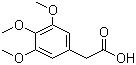 |
| Molecular Formula | C11H14O5 |
| Molecular Weight | 226.23 |
| CAS Registry Number | 951-82-6 |
| EC Number | 213-456-2 |
| SMILES | COC1=CC(=CC(=C1OC)OC)CC(=O)O |
| Density | 1.2±0.1 g/cm3 Calc.* |
|---|---|
| Melting point | 117 - 120 °C (Expl.) |
| Boiling point | 360.8±37.0 °C 760 mmHg (Calc.)* |
| Flash point | 138.1±20.0 °C (Calc.)* |
| Solubility | water: soluble (Expl.) |
| Index of refraction | 1.52 (Calc.)* |
| * | Calculated using Advanced Chemistry Development (ACD/Labs) Software. |
| Hazard Symbols |  GHS07 Warning Details GHS07 Warning Details | ||||||||||||||||||||
|---|---|---|---|---|---|---|---|---|---|---|---|---|---|---|---|---|---|---|---|---|---|
| Risk Statements | H315-H319-H335 Details | ||||||||||||||||||||
| Safety Statements | P261-P264-P264+P265-P271-P280-P302+P352-P304+P340-P305+P351+P338-P319-P321-P332+P317-P337+P317-P362+P364-P403+P233-P405-P501 Details | ||||||||||||||||||||
| Hazard Classification | |||||||||||||||||||||
| |||||||||||||||||||||
| SDS | Available | ||||||||||||||||||||
 chemBlink Chemical Story
|
3,4,5-Trimethoxyphenylacetic acid, CAS 951-82-6, is an aromatic carboxylic acid used as an intermediate in organic synthesis and also known as a metabolite of mescaline. Its molecular formula is C11H14O5 and its molecular weight is 226.23. Structurally, it contains a phenylacetic acid side chain attached to an aromatic ring bearing three adjacent methoxy groups at the 3-, 4-, and 5-positions. The arrangement of those three methoxy groups gives the molecule a recognizable connection to a number of natural products and biologically studied aromatic compounds. One particularly interesting connection is mescaline. Mescaline is 3,4,5-trimethoxyphenethylamine. Its structure contains the same 3,4,5-trimethoxyphenyl ring found in 3,4,5-trimethoxyphenylacetic acid. The important difference lies at the end of the two-carbon side chain. Mescaline can be represented in simplified form as: (CH3O)3C6H2-CH2-CH2-NH2 3,4,5-Trimethoxyphenylacetic acid can be represented as: (CH3O)3C6H2-CH2-CO2H The aromatic portion is retained. The terminal chemistry changes dramatically. This relationship was recognized in metabolic studies many decades ago. A 1961 report in Nature specifically identified 3,4,5-trimethoxyphenylacetic acid as a major metabolite of mescaline in dogs. The underlying chemistry belongs to a common biological pathway for primary amines. Oxidative deamination can transform an amine-containing side chain into an aldehyde intermediate. Further oxidation of that aldehyde produces the corresponding carboxylic acid. In simplified form: Ar-CH2-CH2-NH2 → Ar-CH2-CHO → Ar-CH2-CO2H For mescaline, Ar is the 3,4,5-trimethoxyphenyl group. The transformation therefore provides a clear example of metabolism changing one end of a molecule while leaving another major structural region recognizable. The three methoxy groups remain attached to the aromatic ring. The carbon skeleton remains recognizable. But the nitrogen-containing end has become a carboxylic acid. This is one reason metabolites are so informative in biochemical research. By identifying the structures of molecules excreted after administration of a compound, researchers can reconstruct some of the chemical transformations that occurred inside the organism. Historical work on mescaline metabolism also shows why biological metabolism cannot always be reduced to a single numerical statement. Early investigators reported substantially different proportions of unchanged mescaline and 3,4,5-trimethoxyphenylacetic acid in animal studies. The 1961 Nature report discussed this disagreement explicitly. Such differences can arise from experimental conditions, route of administration, analytical methods, biological variation, and other factors. The important conclusion is therefore not that one fixed percentage must always be converted. It is that oxidation to 3,4,5-trimethoxyphenylacetic acid is a documented metabolic pathway of mescaline. The same compound has another identity in the laboratory. Instead of being the end product of molecular breakdown, 3,4,5-trimethoxyphenylacetic acid can be used as a starting material for building larger molecules. Its carboxylic acid group can be converted into esters, amides, acid chlorides, and other derivatives. The carbon adjacent to the aromatic ring provides a short spacer between the 3,4,5-trimethoxyphenyl group and the carboxyl functionality. This structural pattern has appeared in the synthesis of a variety of biologically investigated compounds and natural-product-related structures. Published literature includes its use in chemistry associated with colchicine-related structures and colchinol derivatives. A classic 1951 study on the synthesis of dl-colchinol methyl ether included 3,4,5-trimethoxyphenylacetic acid chemistry. The same 3,4,5-trimethoxy aromatic pattern also appears prominently in other natural-product families and medicinal-chemistry structures. For example, published synthetic work directed toward combretastatin-related compounds has used 3,4,5-trimethoxyphenylacetic acid or derivatives prepared from it as part of routes to more elaborate aromatic systems. This does not mean that 3,4,5-trimethoxyphenylacetic acid possesses the biological activities of colchicine, combretastatins, mescaline, or compounds synthesized from it. Those activities belong to complete molecular structures. Its importance is more fundamental: it provides a compact and already assembled 3,4,5-trimethoxyphenyl building block attached to a chemically versatile acetic-acid side chain. There is an interesting contrast between its biological and synthetic roles. In metabolism, a more complex nitrogen-containing molecule can be oxidized until 3,4,5-trimethoxyphenylacetic acid appears as a product. In organic synthesis, chemists can begin with this acid and use its carboxyl group to construct something more complex. One direction simplifies. The other builds. The molecule sits between the two. This also demonstrates an important principle of molecular identity. Metabolism does not always destroy every recognizable feature of a molecule at once. Sometimes one region is chemically rewritten while another survives almost unchanged. In the conversion associated with mescaline metabolism, the 3,4,5-trimethoxyphenyl pattern acts almost like a structural fingerprint that remains visible after the side chain has been oxidized. A molecule that appears in a catalog as an ordinary aromatic acid can therefore tell two very different chemical stories. To a synthetic chemist, it is a building block. To a metabolism researcher, it is evidence of where another molecule has been. References 1. NIST Chemistry WebBook. 3,4,5-Trimethoxyphenylacetic acid, CAS 951-82-6. Molecular formula C11H14O5; molecular weight 226.2259. 2. Spector, E. (1961). "Identification of 3,4,5-Trimethoxyphenylacetic Acid as the Major Metabolite of Mescaline in the Dog." Nature, 189, 751-752. 3. Charalampous, K. D.; Orengo, A.; Walker, K. E.; Kinross-Wright, J. (1964). Studies concerning mescaline metabolism. Journal of Pharmacology and Experimental Therapeutics, 145, 242-246. 4. Riceberg, L. J.; Simon, M.; Van Vunakis, H.; Abeles, R. H. (1975). Studies concerning the metabolism of mescaline. Biochemical Pharmacology, 24, 119-125. 5. Rapoport, H.; Williams, A. R.; Cisney, M. E. (1951). "The synthesis of dl-colchinol methyl ether." Journal of the American Chemical Society, 73, 1414-1421. |
| Market Analysis Reports |