Online Database of Chemicals from Around the World

Diethyl carbonate
[CAS# 105-58-8]

Top Active Suppliers
Hangzhou Verychem Science And Technology Co., Ltd. China Inquire  
+86 (571) 8816-2785
+86 13606544505
lucy@verychem.com
Chemical manufacturer since 2004
chemBlink massive supplier since 2021
Simagchem Corporation China Inquire  
+86 13806087780
sale@simagchem.com
Chemical manufacturer since 2002
chemBlink standard supplier since 2008
Qingdao On-Billion Import and Export Co., Ltd. China Inquire  
+86 (571) 8591-8425
amandacui@obn.com.cn
Chemical distributor
chemBlink standard supplier since 2010
Hefei TNJ Chemical Industry Co., Ltd. China Inquire  
+86 (551) 6541-8684
sales@tnjchem.com
Chemical manufacturer since 2001
chemBlink standard supplier since 2010
Ring Specialty Chemicals Inc. Canada Inquire  
+1 (416) 493-6870
info@ringchemicals.com
Chemical distributor
chemBlink standard supplier since 2010
BOC Sciences USA Inquire  
+1 (631) 485-4226
info@bocsci.com
Chemical manufacturer
chemBlink standard supplier since 2010
Guangzhou Tinci Materials Technology Co., Ltd. China Inquire  
+86 (20) 8225-1159
zhangcuicui@tinci.com
Chemical manufacturer
chemBlink standard supplier since 2011
VanDeMark Chemical Inc. USA Inquire  
+1 (716) 433-6764
sales@vandemark.com
Chemical manufacturer since 1951
chemBlink standard supplier since 2012
Complete supplier list of Diethyl carbonate
Identification
Classification Organic raw materials >> Inorganic acid ester
Name Diethyl carbonate
Synonyms Carbonic ether; Ethyl carbonate; Eufin
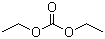
Molecular Structure CAS # 105-58-8, Diethyl carbonate, Carbonic ether, Ethyl carbonate, Eufin
Molecular Formula C5H10O3
Molecular Weight 118.13
CAS Registry Number 105-58-8
EC Number 203-311-1
SMILES CCOC(=O)OCC
Properties
Density 1.0±0.1 g/cm3 Calc.*, 0.975 g/mL (Expl.)
Melting point -43 ºC (Expl.)
Boiling point 126.8 ºC 760 mmHg (Calc.)*, 126 - 128 ºC (Expl.)
Flash point 31.1 ºC (Calc.)*, 25 ºC (Expl.)
Solubility water: Negligible (Expl.)
Index of refraction 1.391 (Calc.)*, 1.384 (Expl.)
* Calculated using Advanced Chemistry Development (ACD/Labs) Software.
Safety Data
Hazard Symbols symbol symbol   GHS02;GHS07 WarningGHS02    Details
Hazard Statements H226-H315-H319-H335    Details
Precautionary Statements P210-P233-P240-P241-P242-P243-P261-P264-P264+P265-P271-P280-P302+P352-P303+P361+P353-P304+P340-P305+P351+P338-P319-P321-P332+P317-P337+P317-P362+P364-P370+P378-P403+P233-P403+P235-P405-P501    Details
Hazard Classification
up    Details
HazardClassCategory CodeHazard Statement
Flammable liquidsFlam. Liq.3H226
Skin irritationSkin Irrit.2H315
Specific target organ toxicity - single exposureSTOT SE3H335
Eye irritationEye Irrit.2H319
Eye irritationEye Irrit.2AH319
Transport Information UN 2366
SDS Available
up Discovory and Applicatios
Diethyl carbonate is an organic carbonate ester with the molecular formula C5H10O3. Structurally, it consists of a central carbonyl group (C=O) bonded to two ethoxy groups (–OCH2CH3), giving it the general structure of a symmetrical dialkyl carbonate. It is a colorless, flammable liquid with a mild odor, low viscosity, and moderate solubility in water, while being miscible with most organic solvents.

Diethyl carbonate is primarily used as a reactive solvent and chemical intermediate in organic synthesis. Its carbonate functionality allows it to participate in transesterification reactions, transferring the carbonate group to alcohols or amines to produce dialkyl carbonates or carbamates. It is also employed in alkylation reactions as a source of the ethyl carbonate group in carboxylation or alkylation processes. Because of its relatively low toxicity and biodegradability, diethyl carbonate is considered a green reagent and has gained interest as a replacement for more hazardous alkylating agents such as phosgene or dimethyl sulfate.

In industrial chemistry, diethyl carbonate serves as a precursor in the synthesis of polycarbonates, polyurethanes, and other polymeric materials. It reacts with diols to form polycarbonate chains through transesterification, providing an alternative to phosgene-based polycarbonate production. Its use in polymer chemistry allows for the preparation of environmentally friendlier materials with reduced toxic byproducts.

Diethyl carbonate is also used as a solvent in lithium-ion batteries and other electrochemical applications. Its high dielectric constant and ability to dissolve lithium salts make it suitable as a component in electrolyte solutions, often combined with other carbonate solvents to optimize conductivity, viscosity, and electrochemical stability.

Synthetically, diethyl carbonate can be produced by phosgene-free methods such as the reaction of ethanol with urea, oxidative carbonylation of ethanol using carbon monoxide and oxygen, or transesterification of dimethyl carbonate with ethanol. These methods are preferred for industrial production due to safety and environmental considerations.

Overall, diethyl carbonate is a versatile and valuable organic carbonate, notable for its use as a green solvent, chemical intermediate, and polymer precursor. Its structure, featuring a central carbonate group flanked by two ethyl groups, underpins its reactivity in transesterification, alkylation, and polymerization reactions, while its physical properties make it useful in a range of industrial and laboratory applications.

References

2014. Stable Cycling of SiO2 Nanotubes as High-Performance Anodes for Lithium-Ion Batteries. Scientific Reports, 4.
DOI: 10.1038/srep04605

2012. Inexpensive method for producing macroporous silicon particulates (MPSPs) with pyrolyzed polyacrylonitrile for lithium ion batteries. Scientific Reports, 2.
DOI: 10.1038/srep00795

2005. Direct Yellow and Methylene Blue liquid-liquid extraction with alkylene carbonates. Chemosphere, 60(8).
DOI: 10.1016/j.chemosphere.2005.01.019
Market Analysis Reports
List of Reports Available for Diethyl carbonate
Related Products
Diethyl bromomalonate  Diethyl 2-bromo-2-methylmalonate  Diethyl (4-bromophenyl)phosphonate  N,N-Diethylbutylamine  Diethyl butylmalonate  Diethylcarbamazine  Diethylcarbamic acid 2-norbornylidenedimethylene ester  Diethylcarbamodithioic acid - cadmium  Diethylcarbamodithioic acid 2-cyanoethyl ester  Diethylcarbamyl chloride  Diethyl carboxymethylphosphonate  N,N-Diethylchloroacetamide  Diethyl [(2-chloroethoxy)methyl]phosphonate  Diethyl chloromalonate  Diethyl 2-chloro-3-oxosuccinate  Diethyl chlorophosphate  Diethyl chlorophosphite  N,N-Diethyl-2-chloropropionamide  Diethyl 4-chloropyridine-2,6-dicarboxylate  Diethyl chlorothiophosphate