
Online Database of Chemicals from Around the World
| Simagchem Corporation | China | Inquire | ||
|---|---|---|---|---|
 |
+86 13806087780 | |||
 |
sale@simagchem.com | |||
| Chemical manufacturer since 2002 | ||||
| chemBlink standard supplier since 2008 | ||||
| Tianjin Zhongxin Chem-tech Co., Ltd. | China | Inquire | ||
|---|---|---|---|---|
|
+86 (22) 6688-0623 | |||
|
sales@tjzxchem.com | |||
| Chemical manufacturer since 2007 | ||||
| chemBlink standard supplier since 2009 | ||||
| Anhui Royal Chemical Co., Ltd. | China | Inquire | ||
|---|---|---|---|---|
|
+86 (25) 8663-9253 | |||
|
zoey.zhao@royal-chem.com | |||
| Chemical manufacturer since 2008 | ||||
| chemBlink standard supplier since 2019 | ||||
| Classification | Organic raw materials >> Aryl compounds >> Anilines |
|---|---|
| Name | N-Butyl-N-2-hydroxyethylaniline |
| Synonyms | 2-(N-Butylanilino)ethanol |
| Molecular Structure | 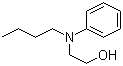 |
| Protein Sequence | G |
| Molecular Formula | C12H19NO |
| Molecular Weight | 193.28 |
| CAS Registry Number | 3046-94-4 |
| EC Number | 221-253-5 |
| SMILES | CCCCN(CCO)C1=CC=CC=C1 |
| Density | 1.0±0.1 g/cm3, Calc.* |
|---|---|
| Index of Refraction | 1.558, Calc.* |
| Boiling Point | 341.4±25.0 ºC (760 mmHg), Calc.* |
| Flash Point | 124.7±13.8 ºC, Calc.* |
| * | Calculated using Advanced Chemistry Development (ACD/Labs) Software. |
 Discovory and Applicatios
|
N-Butyl-N-2-hydroxyethylaniline, commonly referred to as N-butyl-2-hydroxyethylaniline, is an organic compound notable for its applications in various industrial processes, particularly in the fields of coatings, adhesives, and rubber production. The compound belongs to the class of amines and is characterized by the presence of a butyl group and a hydroxyl-ethanol group attached to the aniline structure. Its discovery can be traced back to the expanding interest in functionalized amines in the mid-20th century, a period marked by significant advancements in synthetic chemistry. The synthesis of N-butyl-N-2-hydroxyethylaniline typically involves the alkylation of aniline with 2-hydroxyethyl bromide or chloride in the presence of a suitable base. This process allows for the introduction of the butyl group, resulting in a compound that exhibits enhanced solubility and reactivity. The unique structure of N-butyl-N-2-hydroxyethylaniline imparts properties that make it particularly useful in industrial applications. One of the primary applications of N-butyl-N-2-hydroxyethylaniline is as an intermediate in the production of various polymers and resins. Its ability to participate in polymerization reactions makes it an essential component in the formulation of epoxy resins and coatings. These materials are widely used in construction, automotive, and aerospace industries due to their excellent adhesion, chemical resistance, and durability. By incorporating N-butyl-N-2-hydroxyethylaniline into resin formulations, manufacturers can enhance the performance characteristics of the final products, improving their suitability for demanding applications. In the coatings industry, N-butyl-N-2-hydroxyethylaniline serves as a hardener or curing agent in epoxy and polyurethane systems. When combined with resin components, it helps to facilitate the curing process, leading to the formation of strong, resilient films. This property is particularly valuable in protective coatings that require resistance to chemicals, abrasion, and environmental degradation. The incorporation of this compound not only enhances the curing speed but also improves the mechanical properties of the resulting coatings. Another significant application of N-butyl-N-2-hydroxyethylaniline is in the formulation of adhesives. The compound's reactivity with various substrates allows it to be used in creating strong bonds in different materials, including metals, plastics, and ceramics. Its versatility makes it an ideal choice for industries where high-performance adhesives are essential, such as construction and automotive manufacturing. By optimizing adhesive formulations with N-butyl-N-2-hydroxyethylaniline, manufacturers can achieve enhanced bond strength and durability. Additionally, N-butyl-N-2-hydroxyethylaniline has potential applications in the rubber industry. It can be utilized as an accelerant or modifier in the vulcanization process, improving the properties of rubber compounds. The compound’s ability to enhance cross-linking reactions contributes to the production of rubber materials with improved elasticity, heat resistance, and overall performance. In the context of safety and environmental considerations, N-butyl-N-2-hydroxyethylaniline is subject to regulatory scrutiny. As with many chemical substances, proper handling and adherence to safety guidelines are crucial to mitigate any potential health risks. Regulatory agencies evaluate the safety profiles of chemical compounds to ensure that they are used responsibly and in accordance with established guidelines. In summary, N-butyl-N-2-hydroxyethylaniline is a versatile organic compound with significant applications across various industries, including coatings, adhesives, and rubber production. Its unique chemical structure imparts desirable properties that enhance the performance of materials in demanding environments. As research continues to explore the potential of functionalized amines, N-butyl-N-2-hydroxyethylaniline remains a key player in the development of high-performance industrial products. |
| Market Analysis Reports |
| List of Reports Available for N-Butyl-N-2-hydroxyethylaniline |