
Online Database of Chemicals from Around the World
| Shandong E.Fine Pharmacy Co., Ltd. | China | Inquire | ||
|---|---|---|---|---|
 |
+86 (531) 8181-4810 +86 15053131565 | |||
 |
116336356@qq.com | |||
 |
QQ chat | |||
| Chemical manufacturer since 2010 | ||||
| chemBlink standard supplier since 2008 | ||||
| SL Drugs and Pharmaceuticals Pvt. Ltd. | India | Inquire | ||
|---|---|---|---|---|
|
+91 (40) 6661-1133 | |||
|
enquiry@sldrugs.com | |||
| Chemical distributor since 1999 | ||||
| chemBlink standard supplier since 2010 | ||||
| BOC Sciences | USA | Inquire | ||
|---|---|---|---|---|
|
+1 (631) 485-4226 | |||
|
info@bocsci.com | |||
| Chemical manufacturer | ||||
| chemBlink standard supplier since 2010 | ||||
| Classification | Organic raw materials >> Organic sulfur compound |
|---|---|
| Name | Dimethylsulfoniopropionate |
| Synonyms | 3-dimethylsulfoniopropanoate |
| Molecular Structure | 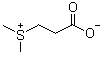 |
| Molecular Formula | C5H10O2S |
| Molecular Weight | 134.20 |
| CAS Registry Number | 7314-30-9 |
| EC Number | 802-067-9 |
| SMILES | C[S+](C)CCC(=O)[O-] |
| Hazard Symbols |
 GHS07 Warning Details
 | ||||||||||||||||||||
|---|---|---|---|---|---|---|---|---|---|---|---|---|---|---|---|---|---|---|---|---|---|
| Hazard Statements | H315-H319 Details | ||||||||||||||||||||
| Precautionary Statements | P264-P264+P265-P280-P302+P352-P305+P351+P338-P321-P332+P317-P337+P317-P362+P364 Details | ||||||||||||||||||||
| Hazard Classification | |||||||||||||||||||||
| |||||||||||||||||||||
 Discovory and Applicatios
|
Dimethylsulfonylpropionate (DMSP) is a naturally occurring organosulfur compound found in marine algae, phytoplankton, and some higher plants. It plays a vital role in the marine sulfur cycle and has a wide range of applications in ecology, biochemistry, and environmental science. DMSP was first discovered in marine algae in the 1940s and was later identified as an important component of marine phytoplankton. Its role in marine ecosystems, particularly its conversion to dimethyl sulfide (DMS), which is responsible for the characteristic odor of the ocean, has sparked interest in its biological functions and environmental impacts. The chemical formula of DMSP is C5H10O2S and its molecular weight is 126.19 g/mol. It is a zwitterionic compound, meaning it carries both positive and negative charges in different parts of its structure, which contributes to its stability in aqueous environments. DMSP exists in various forms, including free dissolved DMSP (DMSPd), intracellular DMSP (DMSPi), and particulate DMSP (DMSPp), each of which plays a different role in marine ecosystems. In marine organisms, DMSP acts as an osmolyte, helping to regulate osmotic balance and protect cells from environmental stresses such as salinity changes. It also acts as an antioxidant, scavenging reactive oxygen species (ROS) that can damage cellular structures. Some marine organisms, particularly certain species of bacteria and plankton, can use DMSP as a source of carbon and sulfur. This metabolic pathway contributes to the marine food web, supporting higher trophic levels in marine ecosystems. DMSP is enzymatically broken down by marine bacteria and phytoplankton into dimethyl sulfide (DMS) and acrylic acid. DMS is released into the atmosphere via ocean spray, where it undergoes further chemical reactions to form aerosols. These aerosols can act as cloud condensation nuclei, influencing cloud formation and potentially climate regulation. DMSP plays a key role in the marine sulfur cycle, influencing sulfur fluxes between marine organisms and the atmosphere. Understanding DMSP dynamics helps researchers model the global sulfur cycle and its impact on climate and atmospheric chemistry. DMSP and its breakdown products, particularly DMS, are indicators of ocean productivity and health. Monitoring changes in DMSP concentrations can provide insights into ecosystem responses to environmental stressors such as nutrient availability, temperature changes, and pollution. DMS produced by DMSP and subsequent aerosol formation can affect cloud properties and albedo, which in turn influence regional and global climate patterns. Research continues to explore these complex interactions to improve climate models and projections. DMSP and its derivatives have potential applications in biotechnology, including bioremediation and wastewater treatment. Their ability to promote sulfur cycling and antioxidant activity make them valuable in environmental and industrial settings. Research is exploring the potential medicinal properties of DMSP derivatives, such as antioxidant and anti-inflammatory effects, which would have implications for human health and disease treatment. Future research on DMSP aims to deepen our understanding of its ecological roles, biogeochemical impacts, and potential applications in biotechnology and medicine. Advances in analytical techniques and environmental monitoring will enhance our ability to study DMSP dynamics and its broader impacts on marine and terrestrial ecosystems. |
| Market Analysis Reports |
| List of Reports Available for Dimethylsulfoniopropionate |