
Online Database of Chemicals from Around the World
| Manus Aktteva | India | |||
|---|---|---|---|---|
 | www.manusaktteva.in | |||
 | +91 (79) 6512-3395 | |||
 | +91 (79) 2646-3395 | |||
 | products@manusakttevabiopharma.in | |||
| Chemical distributor | ||||
| chemBlink Standard supplier since 2008 | ||||
| Taizhou Crene Biotechnology Co., Ltd. | China | |||
|---|---|---|---|---|
| www.pharm-intermediates.com | |||
| +86 (576) 8881-3233 8820-5808 +86 13396860566 | |||
| +86 (576) 8822-9589 | |||
| sales@pharm-intermediates.com | |||
 | QQ Chat | |||
| Chemical manufacturer since 2011 | ||||
| chemBlink Standard supplier since 2009 | ||||
| Zhejiang Ausun Pharmaceutical Co., Ltd. | China | |||
|---|---|---|---|---|
| www.ausunpharm.com | |||
| +86 (576) 8558-9335 +86 13957690608 | |||
| +86 (576) 8558-9168 | |||
| sales@ausunpharm.com | |||
| Chemical manufacturer since 2011 | ||||
| chemBlink Standard supplier since 2009 | ||||
| BOC Sciences | USA | |||
|---|---|---|---|---|
| www.bocsci.com | |||
| +1 (631) 485-4226 | |||
| +1 (631) 614-7828 | |||
| info@bocsci.com | |||
| Chemical manufacturer | ||||
| chemBlink Standard supplier since 2010 | ||||
| Hangzhou Leap Chem Co., Ltd. | China | |||
|---|---|---|---|---|
| www.leapchem.com | |||
| +86 (571) 8771-1850 | |||
| market19@leapchem.com | |||
| QQ Chat | |||
| Chemical manufacturer since 2006 | ||||
| chemBlink Standard supplier since 2015 | ||||
| Shanghai Yingrui Biopharm Co., Ltd. | China | |||
|---|---|---|---|---|
| www.shyrchem.com | |||
| +86 (21) 3358-5366 3466-6753 +86 13311639313 | |||
| +86 (21) 3497-9012 | |||
| sales02@shyrchem.com | |||
| QQ Chat | |||
 | Skype Chat | |||
| Chemical manufacturer since 2009 | ||||
| chemBlink Standard supplier since 2017 | ||||
| Shanghai Forever Synthesis Co.,Ltd. | China | |||
|---|---|---|---|---|
| www.foreversyn.com | |||
| +86 (551) 6288-8437 +86 18096409024 | |||
| sales@foreversyn.com sales02@foreversyn.com | |||
| QQ Chat | |||
| Skype Chat | |||
| Chemical distributor since 2013 | ||||
| chemBlink Standard supplier since 2018 | ||||
| Taizhou Runsun Chemical Co., Ltd. | China | |||
|---|---|---|---|---|
| www.runsunchemical.com | |||
| +86 15867635987 | |||
| sales@runsunchemical.com | |||
| QQ Chat | |||
| Chemical manufacturer since 2015 | ||||
| chemBlink Standard supplier since 2019 | ||||
| Shanghai Finetech pharm Co., Ltd. | China | |||
|---|---|---|---|---|
| www.finetechpharm.cn | |||
| +86 18221039705 | |||
| ad@finetechpharm.cn | |||
| Chemical manufacturer since 2016 | ||||
| chemBlink Standard supplier since 2026 | ||||
| Cayman Chemical Company | USA | |||
|---|---|---|---|---|
| www.caymanchem.com | |||
| +1 (734) 971-3335 | |||
| +1 (734) 971-3640 | |||
| sales@caymanchem.com | |||
| Chemical manufacturer | ||||
| Dalton Pharma Services | Canada | |||
|---|---|---|---|---|
| www.dalton.com | |||
| +1 (416) 661-2102 | |||
| +1 (416) 661-2108 | |||
| chemist@dalton.com | |||
| Chemical manufacturer | ||||
| Santa Cruz Biotechnology, Inc. | USA | |||
|---|---|---|---|---|
| www.scbt.com | |||
| +1 (831) 457-3800 | |||
| +1 (831) 457-3801 | |||
| scbt@scbt.com | |||
| Chemical manufacturer | ||||
| CarboMer, Inc. | USA | |||
|---|---|---|---|---|
| www.carbomer.com | |||
| +1 (858) 552-0992 | |||
| +1 (858) 552-0999 | |||
| sales@carbomer.com | |||
| Chemical manufacturer | ||||
| Classification | API >> Inhibitor drug |
|---|---|
| Name | Latanoprost acid |
| Synonyms | (Z)-7-[(1R,2R,3R,5S)-3,5-Dihydroxy-2-[(3R)-3-hydroxy-5-phenylpentyl]cyclopentyl]hept-5-enoic acid |
| Molecular Structure | 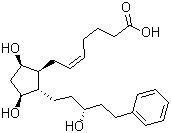 |
| Molecular Formula | C23H34O5 |
| Molecular Weight | 390.51 |
| CAS Registry Number | 41639-83-2 |
| EC Number | 682-021-0 |
| SMILES | C1[C@H]([C@@H]([C@H]([C@H]1O)C/C=CCCCC(=O)O)CC[C@H](CCC2=CC=CC=C2)O)O |
| Density | 1.2±0.1 g/cm3 Calc.* |
|---|---|
| Boiling point | 609.1±50.0 °C 760 mmHg (Calc.)* |
| Flash point | 336.2±26.6 °C (Calc.)* |
| Index of refraction | 1.564 (Calc.)* |
| * | Calculated using Advanced Chemistry Development (ACD/Labs) Software. |
| Hazard Symbols |   GHS06;GHS08 Danger Details GHS06;GHS08 Danger Details | ||||||||||||||||
|---|---|---|---|---|---|---|---|---|---|---|---|---|---|---|---|---|---|
| Risk Statements | H301-H360-H361 Details | ||||||||||||||||
| Safety Statements | P203-P264-P270-P280-P301+P316-P318-P321-P330-P405-P501 Details | ||||||||||||||||
| Hazard Classification | |||||||||||||||||
| |||||||||||||||||
| SDS | Available | ||||||||||||||||
 chemBlink Chemical Story
|
Latanoprost acid is the biologically active free acid form of latanoprost, a synthetic prostaglandin F2α (PGF2α) analogue widely used in ophthalmology to reduce elevated intraocular pressure in glaucoma and ocular hypertension. It belongs to the class of prostanoid receptor agonists, which are structural analogues of endogenous prostaglandins designed to modulate aqueous humor dynamics in the eye. Prostaglandins are lipid-derived signaling molecules produced from arachidonic acid via the cyclooxygenase pathway. They act locally as autacoids and are involved in numerous physiological processes, including inflammation, smooth muscle contraction, and vascular regulation. In the eye, prostaglandin analogues have been developed as potent agents to increase aqueous humor outflow, thereby lowering intraocular pressure and reducing the risk of optic nerve damage. Latanoprost is administered as an isopropyl ester prodrug. After topical application to the eye, it is rapidly hydrolyzed by esterases in the cornea and surrounding tissues to produce latanoprost acid, which is the pharmacologically active species. This hydrolysis step is essential for biological activity, as the esterified form is optimized for corneal penetration rather than receptor binding. Latanoprost acid exerts its pharmacological effect primarily through activation of the prostanoid FP receptor, a G protein–coupled receptor located in ocular tissues such as the ciliary muscle and trabecular meshwork. Activation of this receptor triggers remodeling of the extracellular matrix, particularly in the uveoscleral outflow pathway, leading to increased drainage of aqueous humor from the anterior chamber. This results in a sustained reduction in intraocular pressure. The reduction of intraocular pressure is clinically significant in the management of glaucoma, a group of diseases characterized by progressive optic nerve damage often associated with elevated intraocular pressure. By enhancing aqueous humor outflow rather than suppressing its production, latanoprost acid provides an effective and well-tolerated therapeutic mechanism. Structurally, latanoprost acid is a prostaglandin F2α analogue containing a cyclopentane core with two aliphatic side chains and multiple hydroxyl groups. The molecule possesses several stereocenters, and its three-dimensional configuration is critical for receptor binding and biological activity. Prostanoid receptors exhibit high stereochemical specificity, and even small changes in configuration can significantly affect potency. Compared with endogenous prostaglandins, latanoprost has been chemically modified to enhance metabolic stability and ocular absorption. These modifications allow prolonged intraocular activity following once-daily dosing. Once converted to the acid form, the molecule becomes more polar and is capable of interacting directly with FP receptors in target tissues. Latanoprost acid is relatively lipophilic due to its long hydrocarbon chains but also contains polar functional groups, including hydroxyls and a carboxylic acid moiety. This amphiphilic nature facilitates its partitioning into biological membranes while still allowing receptor interaction in aqueous biological environments. The pharmacological profile of latanoprost acid includes high affinity for FP receptors and a prolonged duration of action within ocular tissues. This contributes to its effectiveness as a first-line therapy for lowering intraocular pressure. Its mechanism of action is distinct from drugs that reduce aqueous humor production, making it a key component of combination therapy strategies in glaucoma management. From a biochemical perspective, prostaglandin analogues such as latanoprost acid are rapidly metabolized in systemic circulation through beta-oxidation and enzymatic oxidation pathways, which limits systemic exposure and contributes to a favorable safety profile. Most of the pharmacological effect is localized to the eye due to topical administration and rapid systemic clearance. Overall, latanoprost acid is the active prostaglandin F2α analogue responsible for the intraocular pressure–lowering effects of latanoprost therapy. Its significance lies in its FP receptor–mediated enhancement of aqueous humor outflow and its established role as a first-line treatment for glaucoma and ocular hypertension. References 2025. Branded Compared with Generic Latanoprost in Glaucoma Therapy: Where Do We Stand?. Advances in Therapy. URL: https://www.ncbi.nlm.nih.gov/pmc/articles/PMC12909429 2025. Different intraocular pressure-lowering effects of latanoprostene bunod across glaucoma subtypes: a 12-month real-world clinical study. Graefe's archive for clinical and experimental ophthalmology = Albrecht von Graefes Archiv fur klinische und experimentelle Ophthalmologie. DOI: 10.1007/s00417-025-07085-0 2023. Structures of human prostaglandin F2α receptor reveal the mechanism of ligand and G protein selectivity. Nature Communications. URL: https://www.ncbi.nlm.nih.gov/pmc/articles/PMC10709307 |
| Market Analysis Reports |